


A new study finds human disease that originates in farmed shrimp
New research shows a link between a virus prevalent in farmed shrimp and a chronic infection that can lead to blindness in people.
In April of 2026, the Red Lobster seafood chain, responding to what it called “endless guest requests,” did a trial revival of its all-you-can-eat Endless Shrimp promotion in a bid to boost waning customer visits. Although the ploy was only a modest success, it’s not difficult to see how the company thought they were on to a winning strategy. Previous, wildly popular shrimp gorge-fests were blamed for Red Lobster’s bankruptcy in 2024 — an indicator not only of Americans’ enthusiasm for a bargain but their growing interest in eating seafood.
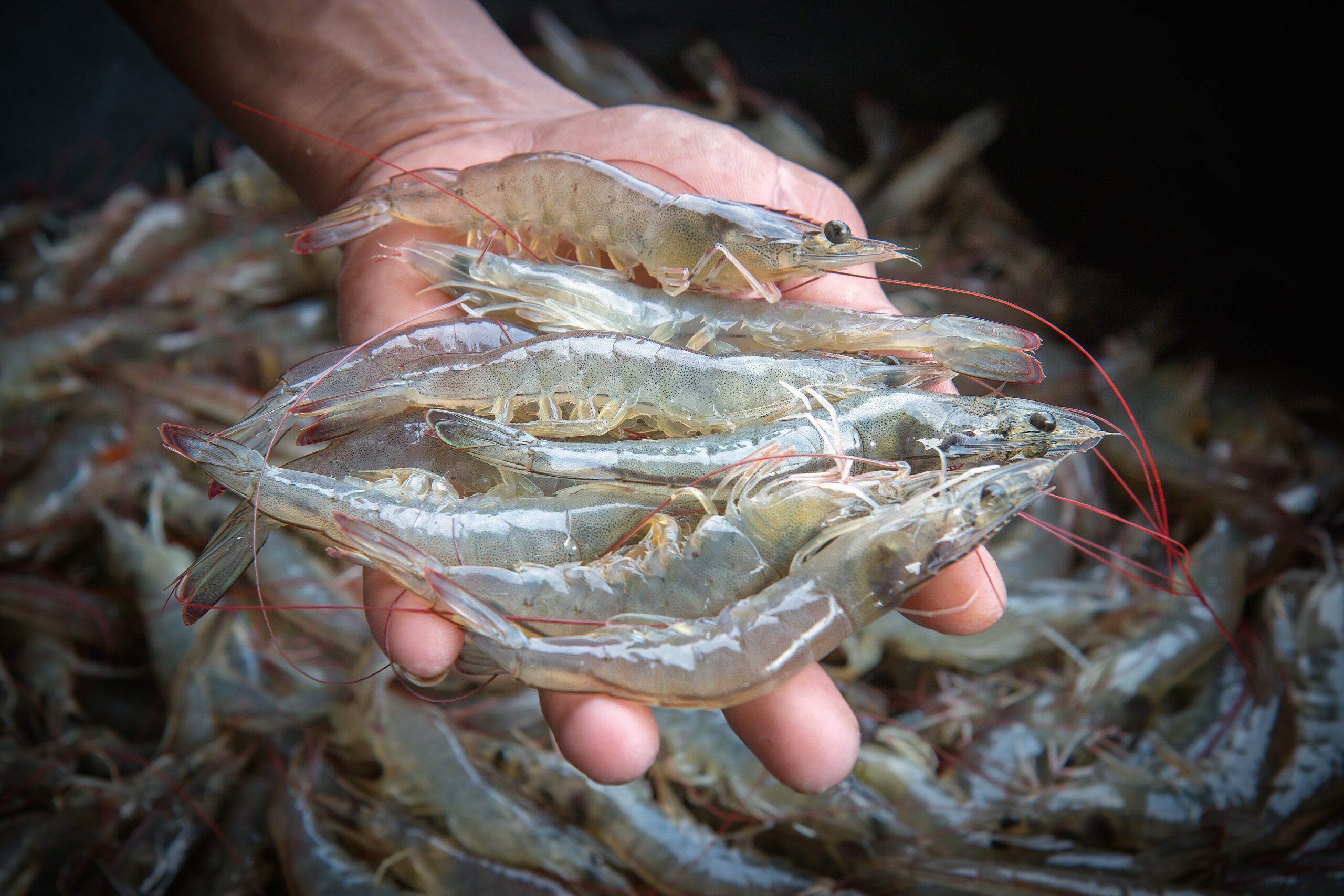
Shrimp is the marine species that we now eat the most of, collectively gobbling some 1.5 billion pounds a year. Its production, however, is fraught. Some 75 to 90 percent of our sea animal consumption comes from imported products and the majority of the shrimp we eat is farmed, usually in muddy ponds near coastal areas in India, Ecuador, Indonesia,Vietnam and Thailand. Shrimp farms are often built on the remains of mangrove forests razed to make way for aquaculture; they’re also responsible for river, ocean and groundwater pollution and increasing antibiotic resistance in humans due to the drugs added to ponds to combat pathogens. In March of 2026, just a month before Red Lobster got ready to boil up thousands of pounds of these favored crustaceans in some of its restaurants, a group of researchers published a paper that gave public health experts a new reason to be concerned about shrimp. Over 28 percent of farmed shrimp samples originating in China tested positive for a virus called covert mortality nodavirus (CMNV) — not a surprise, since CMNV is “quite widespread in the shrimp farm industry,” says Andrew deCoriolis, executive director of anti-factory farm nonprofit Farm Forward. What is surprising is that CMNV has leapt from shrimp to humans, causing a disease called persistent ocular hypertension viral anterior uveitis (POH-VAU), which can, in some rare cases, result in blindness.

The CMNV threat
CMNV has actually “been around for a long time,” says Mansour Samadpour, a microbiologist and cofounder of the Institute for Environmental Health, a food safety testing company. It’s endemic in wild krill and is capable of infecting a number of other aquatic species, including some finfish, crabs and mollusks. More recently, Samadpour says, “It’s been an issue in aquaculture especially, because of the crowding.”
Aquaculture ponds and pens, in which too many genetically homogenous animals are held in cramped conditions in their own waste, allow for the proliferation of numerous pathogens that lead to mass mortalities of those animals. Some of these cross over from farmed to wild fish populations, such as Piscirickettsia salmonis, a bacterium that causes skin and liver lesions and hemorrhaging in fish related to salmon. Some cross over from farmed sea animals to humans; these include Vibrio, a group of bacteria that can cause sometimes life-threatening intestinal infections.
POH-VAU is considered an emerging foodborne infectious disease. Researchers have linked it to CMNV in aquaculture shrimp, although more studies need to be done to determine other possible means of transmission. This marks an unfortunate zoonotic milestone: It is the first known case of a virus originating in farmed aquatic animals to directly cause disease in humans.
For Neil Vora, a former Centers for Disease Control (CDC) epidemic intelligence service officer and now executive director of the Preventing Pandemics at the Source coalition, the increased frequency of disease outbreaks with animal origins is cause for extreme concern. “Look at the big picture: We’ve seen over the last few decades more and more outbreaks of new infectious diseases, and also infectious diseases that we know of, but in new circumstances,” he says, citing bird flu, a hantavirus-infected cruise ship and the Ebola crisis in the Democratic Republic of Congo as three recent examples. When it comes to our food system, we are keeping animals like fish and cows and pigs and chickens “in these cramped, unsanitary conditions so that once a pathogen does get introduced to the population, it can spread really quickly and that gives it a chance to mutate, potentially becoming more dangerous if it were to then infect people.”
Samadpour, whose company is devising a test for CMNV to have on hand for food suppliers, should they want to prove its absence from their supply chains, classifies the current risk of POH-VAU reaching pandemic scale as 0.5 on a scale of 0 to 10. Although depending on how the disease adapts to spread — for example, if it should make its way to the nasal cavity, where it could pass from person to person via sneezing — “It could become a bigger issue … down the line,” he says. A spokesperson for the Food and Drug Administration (FDA) says the agency considers the risk to U.S. consumers to be “extremely low” and is actively monitoring “global surveillance data and tracking incoming research” on POH-VAU.
POH-VAU is a chronic disease, which means it takes a long time for symptoms to develop and the human immune system cannot clear it out. It also comes back time and again, even when treated with antiviral drugs. Although blindness seems for now to be an uncommon result, the disease’s more common manifestations, including irreversible optic nerve damage and severe vision impairment, are serious enough. To date, it has been recorded only in China, among workers who process raw shrimp and home consumers handling and eating raw shrimp. Its seeming geographic isolation, however, “does not mean that we don’t have the same problem in other places,” Samadpour says. “A lot of diseases happen, and they go undetected in public health systems all over the planet.”
Laura Lee Cascada, founder of the Aquaculture Accountability Project, worries that not enough attention is being paid to the potential connections between fish farming and future pandemics. “Aquaculture is framed as this extremely healthy alternative to products like beef, which are seen as full of saturated fat and not climate friendly,” she says. But aquaculture “is the fastest-growing form of factory farming, and it’s basically duplicating the conditions we see [in land-based systems] in water.” Too many fish living in pools of their own feces, antibiotics and other chemicals “creates this stew where viruses and bacteria are amplified and now have ample opportunity to spread. But we haven’t scaled up the public health infrastructure along with the scaling up of the industry.” About 260,000 Americans per year are sickened from diseases tied to sea-animal products, including those sourced from aquaculture.
A growing public health concern
In the U.S., the FDA is responsible for keeping our food system free from pathogens. But as deCoriolis points out, only 2.2 percent of imported foods are tested for safety when they arrive at American ports. Although the POH-VAU–linked shrimp identified in the study originated in China, banning imports from any country is unlikely to make much of a difference to public safety. That’s because the seafood supply chain is incredibly complex and opaque. “The fact that shrimp are sold as commodities, it’s going to be really hard to say, this batch of shrimp came from farms in this area, much less this particular farm,” deCoriolis says. Country-of-origin labeling can also be misleading. For example, “Thailand has a big shrimp-farming industry, but Thailand also imports a lot of shrimp from India and Vietnam, then further processes and packages and sells it as a product in Thailand,” says Cascada. (In fact, Red Lobster sources some of its shrimp from that country, as well as from China, according to its website.) Nevertheless, the FDA says that it uses “a variety of tools to assure imported seafood is safe, wholesome, and properly labeled,” including import alerts that “either prohibit entry or require extra assurances of entries from a specific company, country, or region.” One such alert “precludes aquacultured shrimp, dace, and eel from China and Hong Kong from entering the United States, except for a small number of vetted firms included in the ‘green list.’”
We have the tools to address these [zoonotic] threats. We’re choosing as a society not to invest in them.
Elsewhere in the American public-health safety net, the CDC is responsible for tracking outbreaks of foodborne illnesses and alerting consumers to the risks. “Surveillance is the backbone of public health,” says Vora. But at the moment, “It’s not clear how well coordination is happening within the United States. Morale is at an all-time low at the CDC due to huge cuts to funding and staff cuts, and the communication we’re seeing from CDC around the hantavirus outbreak right now has been really slow. All of us in the United States are worse off for this. Public health keeps us safe. We don’t know about it when it’s functioning well, but when bad things happen, it is paid in the price of lives.” (The CDC did not respond to requests for comment about its efforts to track POH-VAU.)
Vora would like to see a more robust approach to ensuring that POH-VAU and other infectious diseases originating in foods are kept at bay. “We need to be able to understand the signals of pathogens in human populations but also be monitoring what’s happening in domestic animal populations and wild animal populations and in the environment more broadly, so that we are better able to detect threats when they occur and then respond to them,” he says. We also have to be “working together across sectors — not just the human health sector, but people involved in the seafood industry, veterinarians, wildlife specialists, ecologists, people on the regulatory side. This is often in public health referred to as a One Health approach, which recognizes the health of humans is linked to the health of other animals and nature more broadly.”
Although Vora believes it’s the government’s job to ensure Americans’ safety, in this moment of polarization and distrust in federal agencies, he recommends that individuals stay informed about public health threats from university and World Health Organization websites, and by consulting with their doctors. Consumers should also take the usual precautions in handling any raw animal product: Consider wearing gloves when preparing it, cook it thoroughly (heat does kill the CMNV virus, according to Samadpour), and keep raw seafood away from open wounds.
“We have the tools to address these [zoonotic] threats,” Vora says. But right now, “We’re choosing as a society not to invest in them.”
Related Posts
 Seafood & Aquaculture
This fish sauce company is tackling modern environmental issues with an ancient recipe
April 30, 2026
A Maine-based company revives the ancient practice of fermenting fish into garum, reducing waste while preserving flavor.
 Seafood & Aquaculture
The MARA Act would open our oceans to the harms of factory farming
March 18, 2026
The MARA Act could fast-track offshore fish farming and faces widespread opposition from fishermen, scientists and environmental advocates.
 Seafood & Aquaculture
Reimagining wild fisheries with the whole ecosystem in mind
February 13, 2026
Improving fisheries requires rethinking how we prioritize nature, economies of scale and Indigenous voices, say researchers.