


A recent report highlights how Big Technology leaves small farmers behind
As AI transforms agriculture, a new report highlights risks to small farmers and outlines key recommendations to help protect them.
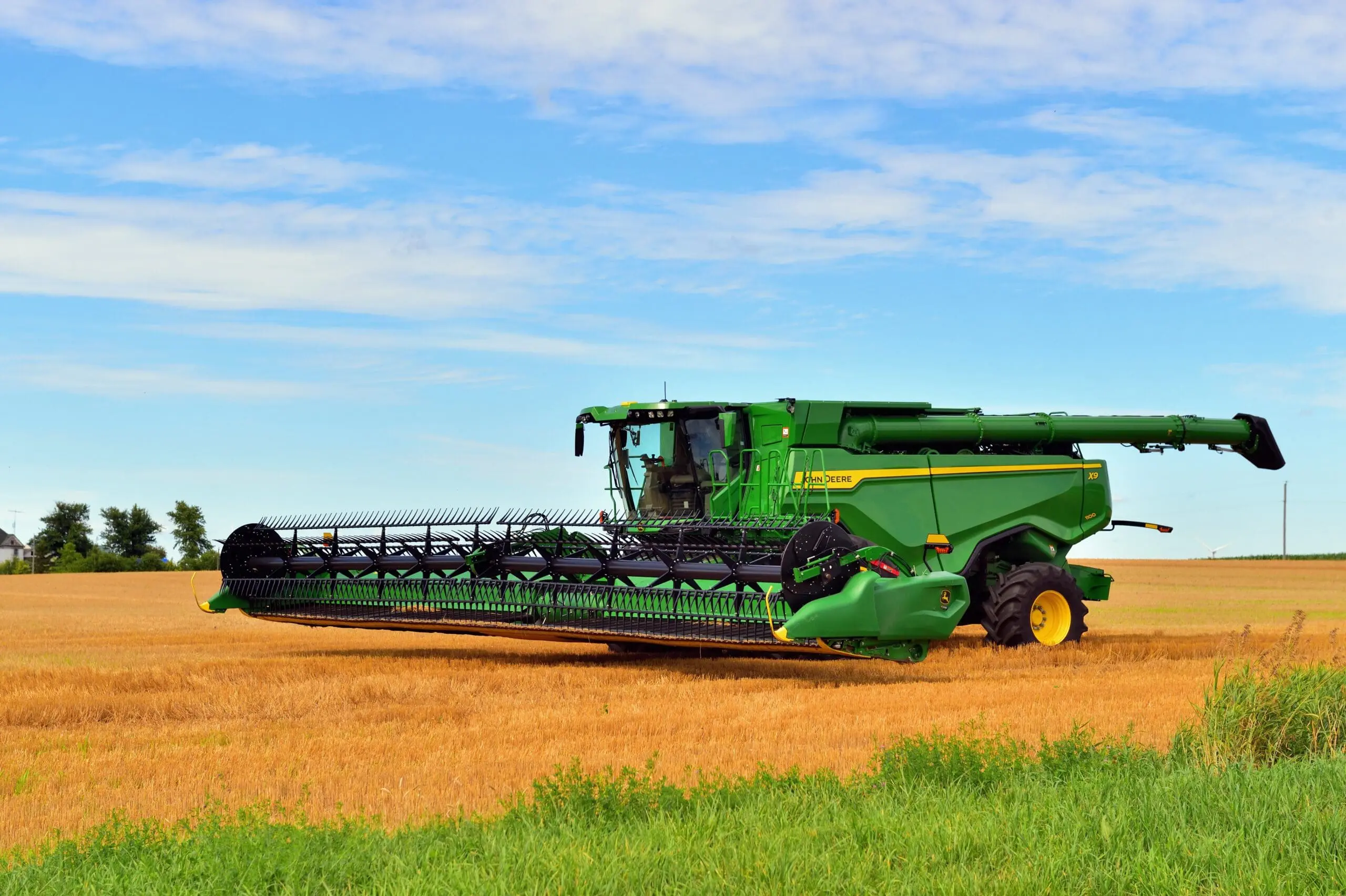
A person accustomed to the stereotypical image of a big, shiny tractor, tricked out with dangerous-looking rows of blades or disks, could be forgiven their confusion over the odd, small machine Collin Goldbach helped design at the MIT GEAR Center. His tractor prototype features a two-wheel–drive motorcycle outfitted with a wedge-shaped piece of iron between the wheels, a miniature hydraulic lift at the back, a plastic tube that blows. Unlike the big, shiny tractor, which is an extremely sophisticated machine, the Bullkey, as it’s called, is made with tiny-scale producers in India in mind, who might otherwise use oxen for field labor.
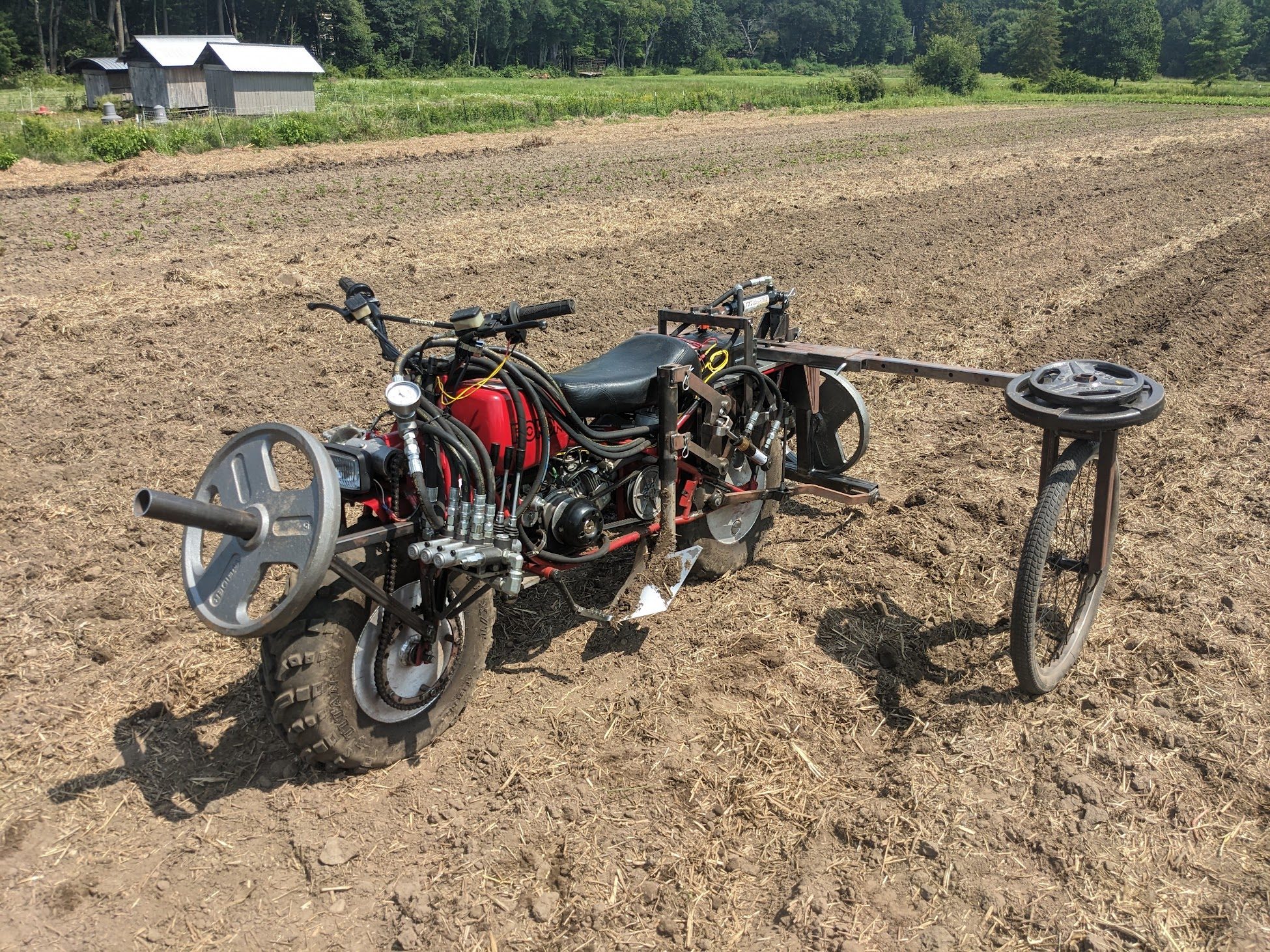
Goldbach’s version of a plowing, hauling, crop-spraying contraption might seem to have little to do with the realities of contemporary American commodity crop production, which relies ever more on “higher tech and higher intelligence and AI-enabled” gizmos, he says, that are both costly to own and require expensive service contracts for repairs. But it speaks to a growing rift between the kinds of machines designed for very large-scale corn and soy farmers, for example, and the needs of “anybody who’s got less than 1,000 acres” — despite so much agricultural consolidation, the vast majority of U.S. farmers worked between 1 and 999 acres in 2022. When it comes to equipment that could serve them, “That’s a niche that is unfilled because all of these companies are driving so hard towards the massive scale,” Goldbach says. It’s even inspired the creation of an annual competition to which makers submit designs for mini-scale electric tractors and mulch blowers and ATV-like vehicles they can’t otherwise find in the marketplace.
The dangers of such focus on the large is the theme of a report by the International Panel of Experts on Sustainable Food Systems (IPES-Food). It raises the alarm about various technologies snowballing throughout agriculture: $1 million “precision” tractors that digitally collect and analyze data; AI-enabled drought-, pest- and disease-sensing tools linked up to satellites; and the facilities where data collected by various machines are stored. Together, write the report’s authors, these represent an alliance between Big Technology and Big Agriculture firms that’s “rapidly gaining control of farming under the guise of innovation,” by “providing cloud platforms and AI-driven decision tools [that are] being integrated into all parts of industrial agriculture, from seeds to chemical inputs to machinery.” And, the report cautions, “Continuing along this pathway risks leaving us with declining ecological resilience, rising farmer debt and bankruptcies, loss of rural jobs [and] erosion of farmer knowledge and autonomy.”
Who controls the data
Pat Mooney is an agricultural development expert and a member of the working group that informed the report. As he explains it, “The major problem with the technology is not that it exists. It is who owns and who controls it.” More and more, that is massive global corporations like Bayer, which own the intellectual property rights to seeds, including those gene-edited with CRISPR. And Elon Musk’s Starlink, whose satellites collect information from tractors and other precision-agriculture machines made by companies like John Deere every time a farmer plows a field. And Google — whose parent company, Alphabet, is currently worth over $3 trillion — which stores that information in water- and energy- guzzling data centers it is building across the country. This creates a whole tentacle of interconnected problems.
One of the big ones for Patti Naylor is the potential loss of farmer expertise, precipitated by a reliance on AI-driven tech. Naylor is a farmer and the president of Family Farm Defenders, a group that supports agroecology (an approach to farming that centers ecological practices). She says AI-driven technology tends to recommend chemical solutions as a default. Additionally, “Sometimes AI is wrong, and you have to be able to check that,” Naylor says. She cites as an example an app that misidentified a prairie plant as invasive and toxic, which a local expert later classified as an important native. But also, when new technologies supplant “the skills that people have, they become just machine operators. And when these kinds of skills that we should have disappear, it’s very hard to get that back.” This is especially troubling in a world rapidly morphing due to climate change, where long-held knowledge of soil health, say — and a farmer’s intuition about when to water or apply nutrients — is more valuable than ever.
It’s a time to actually develop things locally, to have the creative innovation at the local level.
The sidelining of expertise undergirds a central concern of Mooney’s, which is that to better afford advanced technologies, already large-scale farmers will buy more and more land to become bigger and bigger. This drives up land costs, making it less affordable for all producers and even harder for them to stay in business. It also gives more money and power to corporations that understand they can further boost their own profits by vying to control every aspect of an increasingly globalized food supply chain. “With all the climate change issues and the biodiversity and geopolitical concerns that we have, it’s not a time to put more faith in extended supply chains,” says Mooney. “It’s a time to actually develop things locally, to have the creative innovation at the local level,” led by local farmers given tools that will help them meet the challenges of a warming, drying, flooding planet: something like the Bullkey, or a right-sized mulch blower.
Scaling down
How would that work in practice? For Mooney and the IPES-Food team, it starts with more governmental intervention to reset food systems so that they favor more local and regional producers. While tech-enhanced machines certainly exist in places like Canada, that country, along with Brazil, Chile, Mexico and Kenya, Mooney says, has invested in getting more local food into programs like school meals. The U.S. put plenty of money into its own local Farm to School purchasing program over the years; although grants for Farm to School still exist, the current administration has undermined the program by cancelling other monetary support for the very farmers who raise that food, threatening their ability to survive.
From there, Naylor would like to see more innovation specifically on behalf of local farmers. She mentions a South Dakota family dairy farm whose owners have decided to process their own milk because there’s no commercial processor nearby. They could use appropriately scaled technologies to help them test their milk for bacteria. (In India, says Goldbach, the government actually subsidizes farmer equipment purchases.) “What are farmers saying that they need? That’s where [technological development] should be coming from,” Naylor says, not, “what are companies providing for the small farmer?” And she has seen good innovations at work out there, such as apps that allow customers to buy from geographically isolated farmers online — although she does have concerns about how these might affect farmer and farm worker privacy. The trick, she says, is in “finding a balance of what kind of technologies are going to be helpful for us now on our individual farms, but also for society and our future generations and for our planet.”
Teams innovating simple farm technologies at MIT and comparable labs at Brigham Young University and University of Minnesota do have hope that what they’re inventing for the Global South could have implications for farmers in wealthier Northern countries as well — what’s known as reverse innovation. How to scale that is tricky: “As much as I would love to put up a factory and hire some welders and start taking steel tubes into one side and spitting tractors out the other,” Goldbach says, because the Bullkey is such a low-cost product, it would have to be produced at immense volume to make manufacturing affordable. He muses about whether a company like Japan’s Kubota, which already makes compact tractors, might be convinced to take on production. Nevertheless, “That’s why we do what we do,” Goldbach says. “There’s a lot of these problems that you look at them and you just think, there must be a better way.”
Related Posts
 Public Health, The Industrial Food System
Are we getting any closer to defining and labeling ultraprocessed foods?
October 15, 2026
As concerns about ultraprocessed foods grow, defining and regulating them remains a challenge. While California has taken a step toward a clearer definition, meaningful federal policy has stalled.
 Public Health, The Industrial Food System
The ongoing PFAS problem
October 5, 2026
PFAS are once again making headlines as the Trump administration rolls back efforts to regulate and remediate these “forever chemicals.” Here’s what to know about PFAS, how they get into our food and what you can do about them.
 Food Policy & Economics, The Industrial Food System
Preserving farmland for farmers
September 8, 2026
As farmers struggle to afford arable land, a new bill seeks to ban corporate interests from buying the acreages under their feet.