
Can legal challenges against ultraprocessed foods get us to take them seriously?
In early December, the City of San Francisco announced a groundbreaking lawsuit against 10 of the world’s most powerful companies, arguing that they’ve violated state law in making and promoting products that are damaging to health. But the products in question aren’t the vapes, exploding batteries or hazardous household chemicals we’re used to hearing about in consumer protection cases: They’re ultraprocessed foods.
We might not be used to thinking about food this way, but the challenge is in line with how public health and nutrition experts are thinking about ultraprocessed foods (UPFs), those infinitely craveable foods made with ingredients and processes you’d struggle to replicate in a home kitchen. With a recent major series of papers documenting more comprehensively than ever before just how bad UPFs are for us — as well as how they got to be so ubiquitous — suits like San Francisco’s could be a launching point for a much needed reframe on this urgent public health threat.
A public nuisance on par with Big Tobacco

The city is contending that the industry has violated California’s Unfair Competition Law and Public Nuisance Statute by manufacturing and promoting ultraprocessed foods that are ultimately harmful to human health. By definition, a public nuisance interferes with the rights of the public, and the suit alleges that in promoting the sale of cheap, easy-to-overeat foods “whose ingredients and manufacturing processes interrupt our bodies’ abilities to function,” food companies have created a public health threat that warrants the label. The suit also seeks unspecified damages on the basis that cities like San Francisco — along with other local, state and federal governments — have been left to shoulder the immense healthcare costs that have accompanied the rise of UPFs.
The suit claims that the food companies — Kraft Heinz, Mondelez International, Post Holdings, The Coca-Cola Company, PepsiCo, General Mills, Nestlé USA, Mars Incorporated, ConAgra Brands and Kellogg — borrowed from Big Tobacco’s playbook to market harmful products while obscuring their impact from the public. It’s an apt comparison, particularly considering the way the food industry has targeted children with products designed to shape their tastes for life.
And while that comparison between processed foods and smoking might seem hyperbolic, it’s in line with what researchers who study processed foods say about the risks they present.
New evidence, new strategies
San Francisco’s challenge came shortly after the release of a landmark set of papers on UPFs published in The Lancet, a leading medical journal. While a host of other research has already documented the many impacts ultraprocessed foods have on our bodies, the Lancet’s three-paper series is the most comprehensive attempt yet to explore the rise of UPFs, their impacts and what public health policymakers should be doing to curb their consumption.
The first of the three papers consolidates the evidence that UPF consumption has negatively impacted health outcomes, starting by showing how sharply UPF consumption has risen around the world. In the U.S., Canada, the U.K. and Australia, UPFs have represented over 50 percent of calories consumed on a daily basis for decades. But the rest of the world is quickly catching up as food companies introduce more and more products at lower and lower costs to ever-widening markets.
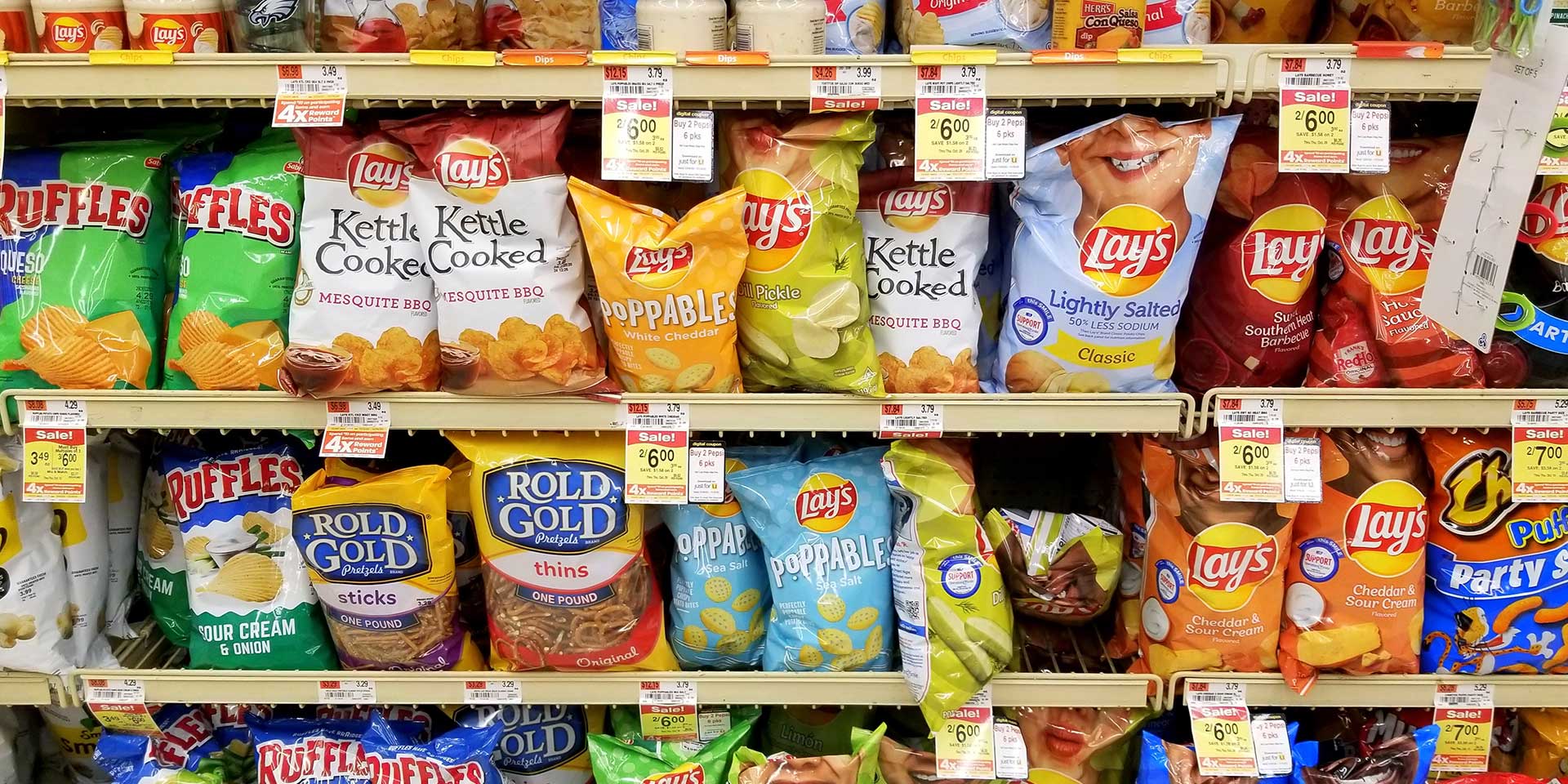
The problem with the increase in UPF consumption is twofold: First, there’s the foods themselves. UPFs are often high in sugar, salt and fat while being low in vitamins, fiber and other nutrients. Some contain potentially harmful additives, and increase our exposure to toxic chemicals and microplastics thanks to contact with processing equipment and packaging. The fact that they’re engineered to taste good while being easy to eat — UPFs provide a lot of calories for very little chewing effort — means that they’re extremely easy to overeat without even realizing, leading to increased caloric intake, consumption of harmful levels of sodium and fat, and exposure to potentially dangerous compounds.
Over 50%
of people's calories are coming from ultraprocessed foods
The second issue is that those UPFs are replacing more traditional, whole and less-processed foods (which are made mainly from whole foods and don’t contain isolates, extracts and additives). Beyond containing fiber, vitamins and protective or beneficial compounds, those foods offer our bodies better feedback on satiety: Higher water content and less-refined ingredients means it takes more time and effort to chew and digest less-processed foods, making it easier to more accurately gauge when you’ve had enough. As whole foods disappear from our diets, regulating the rest of our food intake gets harder and harder.
The first paper concludes with a review of all the health impacts scientists have already attributed to ultraprocessed foods, ranging from the predictable rise in obesity and diabetes to less-obvious problems, like dysfunction in the gut microbiome, hormone disruption, kidney and liver diseases and more. In total, the review found serious health impacts across all major organ systems: a damning indictment.
This review of the available evidence would be useful enough on its own, but the other two papers in the series took the work further by analyzing how we got here and how we might begin to fix it. It’s easy to look at UPF consumption as a personal failing, and in much of U.S. diet culture, that’s how it’s portrayed (with the answer often, ironically, being encouragement to consume different, “healthier” UPFs and supplements). But people have a hard time choosing healthier options when their food environment is so saturated with ultraprocessed options and the marketing about those options is so misleading.
In the second paper, the authors present a few different approaches that would make UPFs easier for consumers to spot and avoid. Changes to labeling laws and educational pushes about the harms of overconsuming UPFs are a good place to start.
Banning marketing to kids, or banning marketing of UPFs altogether, would also be a big help in keeping some of the least nutritious foods off of our minds and out of our shopping carts. Heavier-handed approaches, like implementing taxes on sugary drinks, could also be effective. Bans on ultraprocessed foods in institutional settings like school lunchrooms likewise need to be carefully constructed to ensure they’re actually targeting the foods kids reach for, but they’re also a good place to start, particularly given the influence that UPFs have on impressionable young taste buds.
But these approaches can only go so far without a complementary push to promote healthier foods in their place. Policies that support healthy eating through education, food access and nutrition assistance are also critical.
Shaping consumer behavior is only part of the solution: There are other policy changes that could push companies to reformulate foods to be less harmful, like limits on calories, salt or sugars, or bans on certain additives. Some of these measures have already been passed in some states, albeit with varying degrees of impact: Bans on food dyes might steer companies to reformulate without otherwise making products healthier, for example. Ultimately, policies should also take into account the reason that UPFs are so profitable in the first place: food and farm policies that make easily processed ingredients like corn, soy and sugar cheaper and more plentiful than fruits and vegetables.
But whether policies are designed to shape consumer behavior, remove financial incentives to make ultraprocessed foods, or ban the sale and marketing of UPFs outright, policymakers have consistently hit a big obstacle: The political power of the food industry. As the third and final paper in the series lays out, the food industry has been the main force blocking commonsense reforms to protect public health from the harms of UPFs; it will continue to do so without a concerted effort to rein in its influence. At every level of government, from local to international, policymakers need to prioritize science and health in making decisions about food rather than bending to large multinational corporations.
Can legal challenges shift the conversation?
Of course, disrupting that influence is difficult without disrupting the industry’s huge profits, and it’s that chicken-and-egg problem that’s made it so hard to begin addressing the problem.
That’s where legal efforts like San Francisco’s could be gamechangers. It’s easy to look at the suit and assume it’s a nonstarter: It not only challenges 10 of the world’s most powerful corporations, but also asks us to take UPFs seriously as an urgent health threat when most people just see a packet of chips. But as the experts who authored the Lancet series would argue, that’s precisely the kind of paradigm shift we need to see.
It’s also not unprecedented. Before a California court ruled in favor of Dewayne Johnson, a groundskeeper with a rare cancer, in 2018, it didn’t seem like the general public (or even parts of the scientific establishment) would ever seriously consider that the weedkiller Roundup was dangerous, let alone that a court would hold its manufacturer, Monsanto, accountable for selling it. Now, after thousands of suits and billions paid in damages, Monsanto’s new owner, Bayer, is considering suspending sales, potentially disrupting the chemical’s decades-long hold on the global pesticide market. At the same time, major papers underpinning the safety of glyphosate — which informed later EPA declarations on the subject — have since been retracted thanks to inappropriate ties between the authors and industry. Similar challenges have brought similar results to manufacturers of PFAS, the “forever chemicals” that pollute soil and water, pushing some to commit to phasing out the chemicals.
With UPFs having such demonstrable negative impacts on our health, it’s not unthinkable that the City of San Francisco’s challenge — or a later iteration from another group — could end up having a similar impact.
Top photo by Alexandre Rotenberg/Adobe Stock.
Get the latest news from FoodPrint
By subscribing to communications from FoodPrint, you are agreeing to receive emails from us. We promise not to email you too often or sell your information.
More Reading
California's new folic acid mandate for tortillas sparks controversy over fortified foods
February 27, 2026
Plastics are everywhere in agriculture. Why researchers are worried.
January 22, 2026
Forget the dietary guidelines — Marion Nestle will help you figure out what to eat
January 12, 2026
What to make of the new dietary guidelines
January 9, 2026
MAHA wants to reform food, health and scientific systems — why is it ignoring nitrates?
December 18, 2025
Can MAHA succeed at making America healthy again?
November 19, 2025
How urban orchards improve a community's access to fresh, healthy food
October 30, 2025
School meals are about to get a lot less local — and less healthy
October 22, 2025
The meat industry smeared the Planetary Health Diet. Now its creators are back with more evidence.
October 10, 2025