


Researcher Margiana Petersen-Rockney on farmers’ resistance to “climate change”
Why do some farmers resist climate action? Petersen-Rockney’s “Farmers and Climate Change” examines the social, economic and political factors behind climate reticence in agriculture.
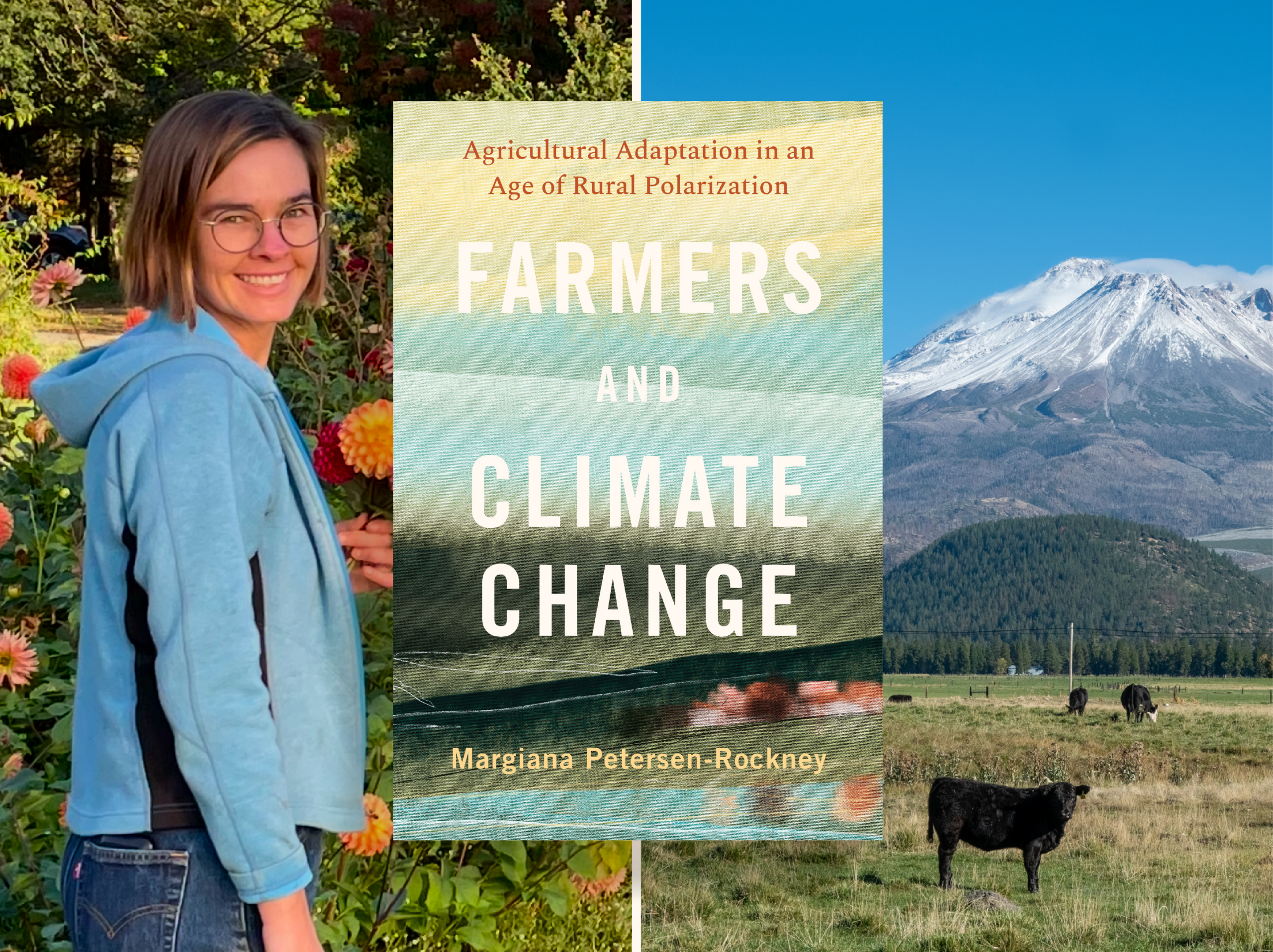
For eight years starting in 2017, Margiana Petersen-Rockney, a political ecology professor at the University of Montana’s W.A. Franke College of Forestry and Conservation, visited with farmers in drought-plagued Siskiyou County in Northern California. On her mind: How these farmers were or were not responding to the challenges that drought — varying in severity here for the better part of the 2000s, partly because of diminished snowpack — threw in their path. And whether they were willing to say it had something to do with climate change.
Anyone who’s spent time with farmers knows that talking with them about climate change can be an odd experience. They may readily concede its existence — although often in secret; they may deny “global warming” but admit that the weather has been unusually unpredictable; they may point out that the climate has always changed throughout history, with or without the actions of humans, and this current moment is no different. Meanwhile, each of them is contending, sometimes on an existential level, with the droughts, flooding, more powerful storms and/or wildfires that a changing climate is unleashing across the planet.
In Petersen-Rockney’s new book, “Farmers and Climate Change,” she unearths a number of reasons for climate reticence. For starters, farmers in rural communities desperately need the support of their communities in order to keep farming; expressing opinions that diverge from the group’s is an almost certain path to ostracism and isolation. They also have a deep distrust of the government, which they see as making their lives harder by enacting climate laws that force them to protect endangered species or adopt water conservation practices they cannot afford. They often feel their needs are overlooked in favor of urbanites who do not understand, or appreciate, the work they do to keep the world fed.
And yet, even farmers who will not concede that climate change exists are taking steps to mitigate it. In Siskiyou, they are turning to “ecological practices that address the root causes of water scarcity,” Petersen-Rockney writes. Leaving land unplanted. Downsizing operations. Choosing drought-tolerant crops. Increasing soil organic matter to “act as a sponge, absorbing water when it is abundant and slowly releasing moisture over dry periods.” Planting cover crops to keep soil cooler and reduce evaporation. Changing grazing to more regenerative methods. All while their neighbors are watching, ready to quietly adopt practices once they see they’re efficient.
FoodPrint talked to Petersen-Rockney about these and other findings from her book. Responses have been edited for length and clarity.
What was the impetus for writing “Farmers and Climate Change”?
Sometimes in the media, farmers get lumped together but actually, it’s a really diverse group of people with a really wide diversity of experiences and beliefs and values operating on the ground. When we gloss over that, we miss opportunities to form alliances that are really important to furthering social or environmental benefits for society. Another thing is understanding why is it that farmers can’t talk about climate change even though they’re experiencing it and have to deal with it. People managing the land hold a really important piece of the puzzle to addressing [climate change] and if we can recognize and honor and reward and appreciate what they’re already doing, we’re going to get further than those narratives of blame that have created the opportunity for farmers and other people whose livelihoods most intimately rely on the land in rural communities, to kind of be captured for a particular political cause.
Environmentalists and farmers are often pitched as adversaries on climate change. But isn’t there a link between wanting a healthy environment and keeping land in farming?
Absolutely. So much of our open space is stewarded by farmers and ranchers. And in Siskiyou, it’s a lot of family-scale farmers and ranchers, which means that most of the labor and the decisions are still being made by a family unit. These aren’t people who live in Manhattan and lease out their land; they’re living there in those communities. When they lose access to their land, it’s often to more extractive industries like data centers or prisons or other industrial uses that have a more negative impact on the environment and on the community. There’s already this idea that if you keep people on the land, they tend to use better [environmental] practices. But [some] farmers use environmentally impactful practices, and a lot of them don’t have a choice about that. Farmers who I’ve worked with, who have adopted chemically intensive practices or intensive tilling or some of these things that we know have a negative impact, they do it because they’re locked into these cycles of production and they’re operating on such slim margins they can’t take a risk to do something differently. With the highly concentrated market of the food system, they may have only a few choices about where to sell what they grow or raise, and often those companies set the terms of production. There are only four companies that control the majority of the chicken industry in the U.S. and those companies tell farmers what kind of grain they have to use, what antibiotic schedule they have to use, so they don’t actually have a choice to change their practices. But it’s often not because a farmer doesn’t want to or doesn’t recognize that there are alternatives that are better.
Among Siskiyou farmers, drought is the climate-related condition that even climate change–deniers will talk about. Why?
Drought feels like something that people can do something about. There’s this idea that wildfires or floods or extreme weather events are acts of God or nature. But the way that farmers experience drought is often as a political choice: Somebody makes a decision that you can’t irrigate or they turn off the irrigation works. Especially in the Western U.S., our water rights system has been about prioritizing agriculture. Now there are big cities that need water. There’s a recognition that tribal communities need water, that the environment needs water, and there just isn’t enough water to go around.
Large agribusinesses have contributed to water scarcity. Do Siskiyou’s farmers see the connection between them and some of their drought woes?
It’s hard to point the finger at the Tysons and the Cargills and the Monsantos of the world when those highly concentrated companies are often offering farmers solutions. You can’t find a market for your product? We’ll give you a contract. You’re experiencing drought? You need this new drought-tolerant seed variety. It’s much easier to point the finger at the government — the experience that a lot of people in rural communities have of the government is one of limitations. It’s one of, You can’t do this and we’re going to take that away and you have to limit this.
Support for farmers from the U.S. Department of Agriculture (USDA) has really tilted the system and created this uneven playing field among agricultural producers; the vast majority of funds for farm support go towards large-scale commodity production. That has left out the farmers who need it the most, the smaller-scale farmers, the farmers of color, diversified farmers. There [were] a lot of conservation and climate-related programs trying to even things out during the Biden administration, through the USDA and the Inflation Reduction Act. Tons of funding was set aside for rural communities for these amazing projects and programs. The people who got it, it made a really big difference. But a lot of that money wasn’t spent before it was clawed back and that created more discontent and a sense that the government, yet again, betrayed us.
If Siskiyou farmers are making meaningful agroecological changes without admitting that climate change is real, how important is it that we all stick to the phrase “climate change”?
In theory, it would be great if we could talk about it, and talk about how beneficial it’s been for a certain set of politicians to use this as a wedge issue, to pit “the people” against “elites.” I feel like we need the pace and scale of climate action to be very different right now. We need to work with the majority of people who steward land who, on average, are much less convinced by climate change or hold a set of political views where climate change has become a litmus test of your political identity. We know from research that trying to educate people about climate change backfires, if they identify as conservative, causing less interest in taking climate action. That doesn’t seem like a good path. So for now, I don’t think it matters if somebody reduces their water use because they want to cut down on their electricity bill for pumping, or because they believe in climate change. Positive actions are happening, not by trying to fight the ideological fight but by finding common ground for meaningful action.
One thing that I think is very powerful is to talk about the next generation. People really do want prosperity and a future for their kids. There’s been research that shows that if you talk about climate action as benefiting farmers, even people who are not farmers in rural communities react more positively to it, because farmers have this cultural cachet in our society. And if you talk about these actions in terms of benefits for the next generation, especially the next generation who might want to farm or stay in rural communities, that also brings people along. What we really need to be resilient in the future is a lot of diversity — biological diversity, diversity of markets, of types of knowledge, of land-management practices. Farmland is going to transfer hands, and if that can be in the hands of a new generation of farmers that’s more diverse in thought, in practice, in identity, we will have a greater variety of [land] practices and activities that will be very positive for our future ability to adapt to impacts of climate change.
Are farmers who are implementing better soil health practices more open to further ecological changes?
Absolutely. Even farmers who were skeptical of some of these ecologically based practices noticed huge differences once they started adopting them. Then they were more open to shifting even more. I heard all the time that people would be looking over the fence to see what their neighbors were doing — let them experiment first. But if that rapid pasture rotation or not tilling as much or integrating different species of livestock together worked, then neighbors started to adopt it, too. A lot of people were really skeptical in 2017 when I started spending time [in Siskiyou]. “I’ll never do that!” Then by 2024, they’re like, “This is amazing; our soil holds so much more water we have to pump way less and our electricity bill is lower.”
Why are the younger generations returning to farm in Siskiyou able to make changes where their parents would or could not?
There are more especially young women who are doing things differently and talking about things in a different way. In the local USDA office and cooperative extension office [which farmers turn to for assistance], those staff have also changed and there is a younger generation who have a different educational background. That can make a big difference in decisions like who gets USDA funding or what sorts of infrastructure is supported. For a while, the local cooperative extension office was staffed mostly by older dudes who were agronomists who studied alfalfa production, and lo and behold, a lot of people started growing alfalfa at scale. Now there’s more support for diversification in the landscape and growing things other than alfalfa, which takes a lot of water and is really expensive to grow.
At the same time, there is less USDA money for climate-smart practices. How can farmers afford to make ecological changes on their land?
It’s really, really hard. My brother is now farming; he loves the work of it, he loves the relationship with the land and the livestock and his vegetable plants. And he is a horrible marketer; he doesn’t even own a computer. So many farmers are like that. When you are a small-scale farmer you have to wear every hat, and I see why it is really appealing to work with a company that will give you a contract and you don’t have to deal with marketing; you don’t have to deal with the pain of showing up at the farmers’ market with your stuff and it’s a rainy day and nobody turns up and you have to put it all in the compost pile. All your hard work and you don’t know if you’re going to be able to cover your costs. People burn out, although one really bright spot is farmer cooperatives. That’s a model where farmers can pool their resources to operate at an economy of scale where they can maybe hire somebody who can do some of that marketing work, to be an accountant, to do PR.
In Siskiyou, a lot of people who were adopting some of these more diversifying practices were turning to national or international networks of other farmers who they saw as doing similar things. Social media was brought up a lot: “I have these farm friends on Instagram who are also doing these agroecological practices,” like regenerative ranching. Since the book wrapped up [in 2025], these practices rapidly went from a fringe-left to a center-right movement with MAHA; suddenly, the politics around these ideas and practices has shifted in a way that weirdly has expanded who’s participating and who can find common ground.
What do you hope readers take away from your book?
There’s a lot of anxiety about the decline of rural communities and people there are struggling to make ends meet — to continue to farm as their parents and grandparents did. They want better things for the land, for the environment, for their kids’ futures, for the local culture and economy and I think understanding that is really essential to understanding what has happened in those places.
Another hope for this book is that it will make places like [Siskiyou], which I think in many ways is similar to a lot of other rural places in the U.S., feel more recognizable or familiar. At this moment especially, there’s such a tendency to demonize the other side or turn off as soon as we hear something that we disagree with. By having a genuine, open curiosity about how people have come to hold the beliefs they hold, there’s some way forward. Everybody wants to experience prosperity and feel respected and appreciated. If we can find that common ground across whatever community and whatever scale, I think it feels very hopeful.
Related Posts
 Food & The Environment, Sustainable Agriculture, The Industrial Food System
Oats can improve soil and water quality. All that’s missing is a market for them.
March 12, 2026
A group of Midwestern oat farmers wants to improve soil and water quality and grow a nutritious local crop. All that’s missing is a market.
 Cooking Sustainably, Food & The Environment
In a beefy moment, beans?
November 4, 2025
Beef prices are soaring right now, up more than 50 percent since 2020, which coincidentally is the year that a lot of people, quarantining at home during a pandemic and facing a shortage of meat at the grocery store, went looking for shelf-stable foods and started getting into beans. “No Longer on the Gassy Periphery, Beans Take Center Stage,” hollered a New York Magazine headline from March 13th of that year. People’s eating (among other things) changed a lot that spring. Also a 2020 reality: the meteoric rise of ultraprocessed fake meat products, with brands like Impossible Foods and Beyond Meat offering plant-based alternatives that could mimic meat’s best qualities, avoid its worst ethical problems, and capture the hearts and bellies of meat eaters, thereby decreasing our dependence on animal proteins.
 Food & The Environment, The Industrial Food System
Can extended producer responsibility programs push food companies to use sustainable packaging?
October 16, 2025
If you’ve ever tried to reduce the amount of plastic that you buy, you’ve probably gotten discouraged pretty quickly: These days, it seems that everything comes wrapped and padded in multiple layers of film, styrofoam and stiff plastic. Without any effective laws curbing plastic use in packaging, companies have little incentive to choose other materials. But what if that were different?