


The promises — and challenges — of lab-grown dairy
Lab-grown dairy promises the taste and texture of conventional dairy without factory farming, offering potential environmental and animal welfare benefits. But what philosophical and regulatory challenges stand in the way of its widespread adoption?
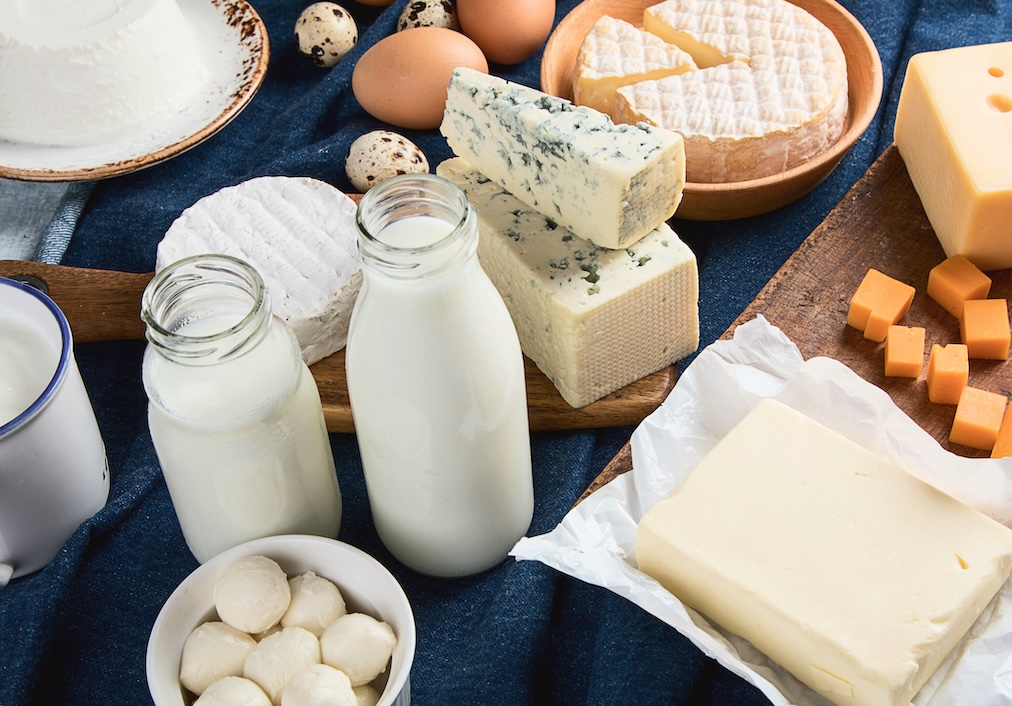
“It’s the ability to produce these proteins in a lab without having to grow an entire cow and separate her baby from her and forcibly impregnate her,” said Jennifer Behr, the director of plant-based initiatives at Mercy For Animals, an international nonprofit. “I mean, it removes so much of the complication and the suffering from the equation. It’s really an amazing technology.”
Behr is discussing the emerging lab-grown dairy market. Instead of milking livestock, producers cultivate cells — either bovine or microbial — in bioreactors to make the key components of milk, such as proteins, fats and sugars. The resulting product can be nearly identical to whole milk, or a mix of milk proteins and plant-based ingredients that closely approximates it. Since both products contain ingredients present in their traditional counterparts, producers claim they more closely mimic the taste, mouthfeel and texture of dairy than many strictly plant-based milks or cheeses (for example, cashew- or soy-based products) — and they’re banking on their appeal to consumers who prefer the flavor and nutritional composition of traditional dairy products but wish to avoid the industry’s downsides.


Trying to compete with traditional and plant-based dairy
Much like strictly plant-based dairy, lab-grown products provide numerous environmental perks. The dairy industry emits 4 percent of our greenhouse gas emissions globally, nearly a sixth of agriculture’s overall emissions. Further, American dairy farms account for 3 percent of our total freshwater withdrawals, while also fueling air and water pollution, land-use change, biodiversity loss and soil erosion. Simply put, animal-free dairy, including plant-based, is much better for the planet than conventional dairy.
“Growing an entire cow is a very resource-intensive process,” said Behr. “It requires lots of land, water, fertilizer, labor and energy to grow the food that is then fed to the cow, so that the cow can then, in turn, produce dairy. … The vast majority of calories you’re putting into the animal don’t actually come out on the other end for human consumption.”
In fact, only 25 percent of calories fed to dairy cows are ultimately converted to milk. Plus, methane emissions from livestock and manure can dramatically increase dairy’s carbon footprint. Animal-free products avoid these, however. But not all consumers who would choose animal-free dairy are keen on the flavor or texture of plant-based, which is where lab-produced alternatives aim to come in.
Producers of lab-grown dairy say their product sidesteps both of these issues, giving people accustomed to traditional dairy what they were expecting — whether the creaminess of cow’s milk or the gooeyness of cheese.
How the milk gets made
The journey from cells to cream involves two main production techniques. One method, precision fermentation, harnesses genetically modified microorganisms, often fungi or bacteria, to create milk proteins from sugars and nutrients. Similar to brewing, the microbes produce casein (which can be made into curds) and whey, the two main proteins found in milk. The mixture is then separated and filtered to extract only the proteins, which are blended with plant-derived fats, carbohydrates, vitamins, minerals and flavors to create dairy products like milk or cheese. Precision fermentation has been used for decades to make a variety of products, including insulin, vitamins and food preservatives. The other, more novel technique involves cultivating a cow’s milk-producing cells to produce all components of whole milk — including proteins, fats, lactose and carbohydrates.
Several companies are already putting these techniques into practice. For example, New Culture, a San Francisco Bay Area startup, is using precision fermentation to create lab-grown dairy products — starting with mozzarella cheese. Their microbes produce only casein, since whey is normally discarded in the cheese-making process.
“Casein is the key ingredient in cheese that is responsible for all these things that we love about it — the melt of mozzarella or the ooze of brie or the crumble of feta,” said Benjamin Freedman, vice president of commercial at New Culture. “It’s all because of casein protein and we make that protein through fermentation. … Previously, you could only get casein from animal milk.”
Their vegan cheese — a mix of microorganism-produced casein and plant-based ingredients — is free from hormones, antibiotics, cholesterol and lactose. Freedman added that it’s comparable to traditional cheese in its amount of protein.
Lab-grown dairy has other advantages as well. “The benefit of those kinds of products is that the taste is very neutral in the protein itself,” said Hanna Tuomisto, a professor of sustainable food systems at the University of Helsinki in Finland. “If you compare it to some other plant-based drinks like a soya drink or oat drink, then you can always taste the flavor of the soya or oat. … The bioavailability, like the digestibility, is also similar.”
The climate benefits
Tuomisto researched the environmental impact of a hypothetical precision-fermented dairy product and found promising results: “Basically, I used an oat drink as a basis and then added 3 percent precision-fermented milk protein to get the protein level at about the same level as in dairy,” she said. “So that product had a 55 percent lower carbon footprint and almost 80 percent lower land use compared to dairy milk.”
New Culture estimated similarly large reductions for its product compared to traditional cheese, lowering greenhouse gas emissions by over 80 percent, while also decreasing land and water use by over 95 percent. This is due to cheese’s significant carbon footprint, which exceeds that of pigs or poultry. It also takes an astonishing 5,000 liters of water to produce one kilogram of cheese.
Of course, animal-free dairy offers upsides for the animals themselves.
“Dairy cows are repeatedly impregnated throughout their lives and forced to carry calves, and then they are separated from those calves when they are just really one or two days old, which is highly distressing and, frankly, heartbreaking for these animals,” said Behr. “It’s been documented that both the calves and the mother cows show signs of distress and anxiety for days after the separation, and this is a cycle that happens again and again throughout the dairy cows’ lives until they are processed or slaughtered.”
Further, male dairy calves can be slaughtered just a few days after birth for use in the veal industry. But the risks of dairy farming extend beyond harm to the animals: It is one of the more hazardous occupations in the U.S. Workers are more likely to suffer from respiratory diseases and are at risk of injury or death from livestock, farming machinery and storage structures like manure pits.
The rise of sustainable dairy
With all these advantages, lab-grown dairy is finding a largely receptive audience. According to a recent report from the Good Food Institute, plant-based milks accounted for more than a third of all plant-based food dollar sales in 2025. Given that plant-based milk alternatives, like soy or almond milk, account for around 14 percent of total milk sales in the U.S., it appears there’s ample room to win over consumers from traditional dairy. In fact, lab-grown dairy is already being sold in the U.S. and Israel, with many other countries soon to follow.
Research has found that over 70 percent of consumers in the U.S. or U.K. would likely buy lab-grown milk, yogurt and cheese if priced similarly to conventional dairy products. Nonetheless, many consumers of lab-grown cheese would also purchase conventional cheese, suggesting that lab-grown and plant-based dairy products may appeal to different segments of the market.
New Culture, for its part, found similar results with its own market research: “We’re not just building a product for vegans,” said Freedman. “We’ve done our own consumer research, and 80 percent of those interested in our cheese eat meat.”
Such consumers may prioritize taste, but also consider the health, environmental and animal-welfare impacts of the dairy industry. Since precise-fermented dairy is lactose-free, it may also appeal to those who have difficulty digesting lactose. However, it contains milk proteins, meaning it isn’t suitable for people with milk allergies. Among vegans, the reaction may be mixed, depending on individual preferences and reasons for following a plant-based diet.
Challenges to lab-grown milk
Consumer acceptance may also vary by country. Vikash Kumar, a research scholar at the National Dairy Research Institute in Haryana, India, points out that some people in his region may be wary of lab-grown products.
“People see it as a taboo; many people are very skeptical, and they don’t trust this type of product …,” said Kumar. “It is a man-made product, and people have a perception that man-made natural products are not good.”
Further, the use of genetically modified organisms may influence consumers’ perceptions.
“Many studies indicate that the genetic engineering of food and trust in biotechnology influence consumers’ willingness to purchase cultivated food,” said Kumar.
Nonetheless, Freedman points out that whether consumers know it or not, the vast majority of cheese in the U.S. already involves GMOs: Genetically modified microbes are used to produce vegetarian rennet, which is used to thicken milk and turn it into cheese. Traditionally, rennet was extracted from calves’ stomachs, making many cheeses that rely on it technically nonvegetarian.
Further, many lab-grown milks in pilot phases currently cost two to three times the price of dairy milk. Added Kumar, “Scaling production is another obstacle, although fermentation technologies are well established. … Producing proteins at a volume comparable to the global dairy industry is quite challenging, and the cost of bioreactors is very high.”
Another hurdle is gaining regulatory approval, though some companies have already secured it and launched products on the market. But again, not all regions are the same.
“In the EU, we have this novel-foods regulation, which is very strict,” said Tuomisto. “So many of them [lab-grown dairy products] that are allowed in the U.S. are not allowed in the EU.”
Lab-grown dairy has its own issues in the U.S. “Mississippi, a couple of months ago, became the first U.S. state to place a ban on the sale of cell-based dairy, which seems premature given that these products are not even widely distributed or available yet,” said Behr. “And, of course, there’s a growing handful of states that have placed bans on the sale of cultivated meat.”
Mississippi, which has also banned lab-grown meat, is striving to promote traditional livestock and dairy farming over alternative proteins.
But compared to the emerging markets for cultivated animal products, whether dairy or meat, precision-fermented dairy may have an advantage.
“For cultivated meat, it’s a brand-new technology,” said Freedman. “It’s growing cells and shaping and scaffolding, whereas precision fermentation has existed for decades. It’s not a new technology. Cultivated meat can be, to my understanding, extremely expensive, whereas precision fermentation, the beauty of it is that you can undercut conventional ingredients.”
Reimagining dairy
With increasing interest in sustainable food, the market for lab-grown dairy is predicted to grow by over 18 percent per year until 2033. Likewise, researchers estimated that lab-grown cheese could capture 33 percent of the U.K. premium dairy cheese market if sold at comparable prices to traditional cheese. Creating lab-grown dairy products could pave the path to a better future — for dairy cows and cheese lovers alike.
“We know that our food system is going to need to change in the coming years and decades just in the light of climate change, and the need to feed a growing population with a finite number of natural resources,” said Behr. “Purely from a sustainability perspective, I think it’s vital that these technologies are given a fair chance to grow and expand.”
Key takeaways
- Lab-grown dairy, which includes milk and cheese made from bovine cells as well as from precision-fermented microbial cells, promises the taste and mouthfeel of traditional dairy without the factory farming of animals, and thus without the climate and animal welfare problems.
- Plant-based milks have the largest market share of all plant-based foods, suggesting that people will accept traditional milk alternatives whether for dietary, health, ethical and/or environmental reasons.
- Some people interested in dairy alternatives dislike the taste or texture of plant-based dairy products. Lab-grown dairy producers are banking on the similarity of their animal-free products to traditional dairy to drive sales.
- Lab-grown dairy faces some philosophical and legislative challenges but with increasing interest in sustainable food, the market is predicted to grow by over 18 percent per year until 2033.
Related Posts
 Public Health, The Industrial Food System
The ongoing PFAS problem
October 5, 2026
PFAS are once again making headlines as the Trump administration rolls back efforts to regulate and remediate these “forever chemicals.” Here’s what to know about PFAS, how they get into our food and what you can do about them.
 Food Policy & Economics, The Industrial Food System
Preserving farmland for farmers
September 8, 2026
As farmers struggle to afford arable land, a new bill seeks to ban corporate interests from buying the acreages under their feet.
 Public Health, The Industrial Food System
Ticks, cyclospora, screwworm: Farmworkers are at risk
September 3, 2026
Farmworkers face daily exposure to parasites, pathogens, pesticides and other hazards, yet their health is often overlooked in broader public-health conversations — even as climate change intensifies these risks.