


Beyond pecan pie: Growers look for new markets for this native nut
There is such diversity in American landscapes that nuts from around the world can be cultivated here seamlessly: Pistachios are a desert crop originally from the Middle East; almonds are from the Mediterranean; cashews are from South America. Only a few nuts are actually native to the United States. Certain strains of walnuts are indigenous, as are piñon. Hickory nuts also fall into this category, though people mainly gather the nuts and bark from wild trees on a small scale. However, there is only one major commercially cultivated nut that features prominently in recipes emblematic of American culinary heritage, and that has grown throughout the country for thousands of years: pecans.
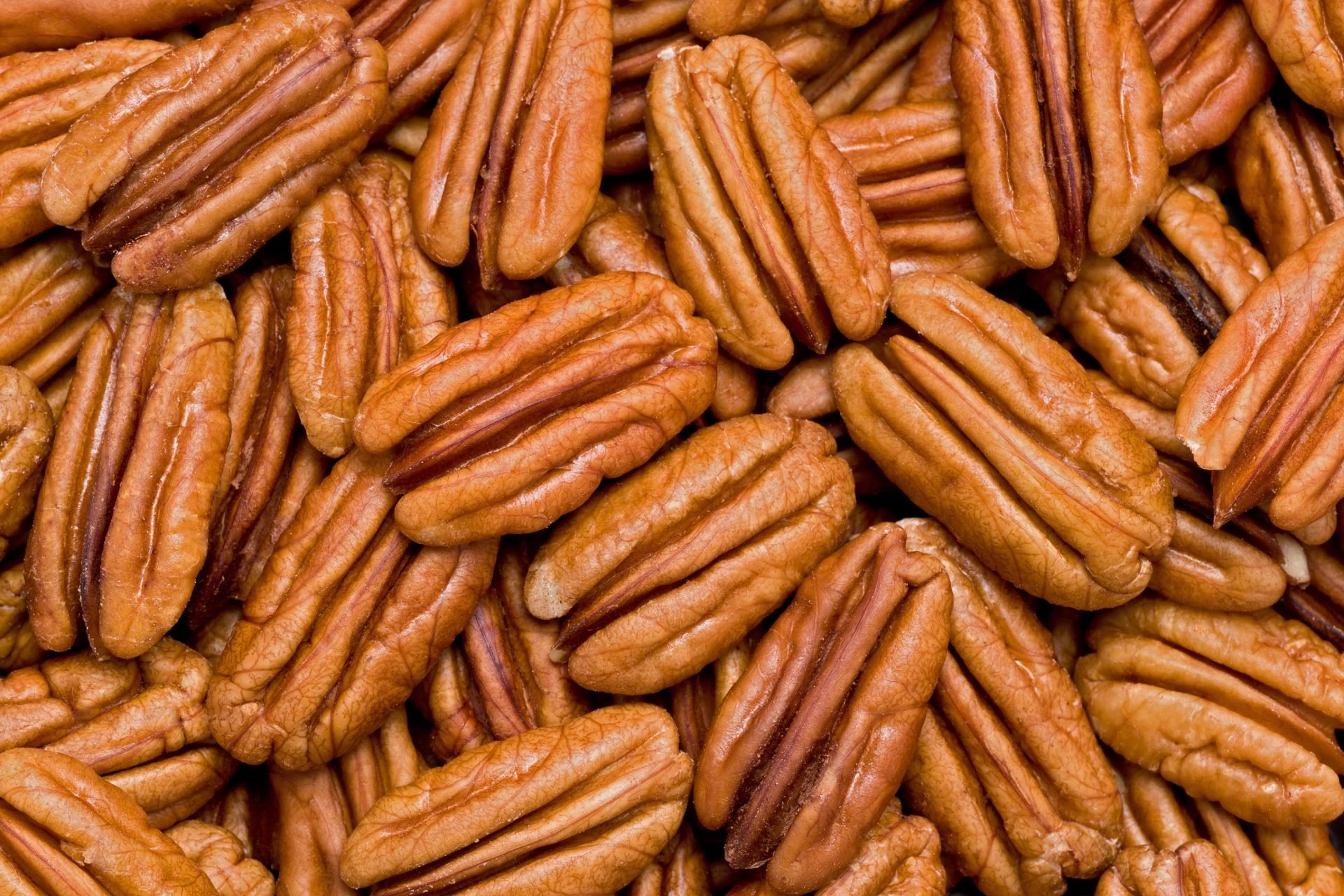
The historic range for pecans spanned the Mississippi River Valley and its tributaries from Iowa to Texas. Since pecan trees historically grew in clustered forests, they became a food that numerous Indigenous peoples incorporated regularly into their diets. In 1729, a French settler in the Mississippi Valley even noted, “The natives have three kinds of walnut trees, some as big as the fist …; the best ones, however, are scarcely larger than the thumb and are called ‘pacanes.’”
Prior to European settlement, pecans were largely eaten whole, but they were also ground down into a meal and incorporated into bread, or combined with bison meat for more caloric sustenance. In fact, “pecan” translates loosely to the Algonquin word for “a nut too hard to crack.” That’s why Indigenous people traditionally boiled the nut and then extracted the buttery meat from the shell.
There are about 1,000 naturally occurring varieties of pecans that have adapted to a wide range of environments, from the damp wetlands around Houston, Texas, to the dry areas around El Paso, Texas, and even the cool winters of Iowa. These days, pecan trees extend beyond their native range: They are cultivated like a wrapping across the lower half of the country in what is known as the Pecan Belt, which runs from the Carolinas to California.
As there is a broader push toward more sustainable farming practices and localized foodways, is greater pecan production a feasible path forward for farms throughout the country? Should more farmers incorporate pecans onto their farms for environmental benefits, and if so, why?
Modern cultivation
Richard Heerema, the extension pecan specialist for New Mexico State University, says that the native range for pecans did not actually include some of the biggest production areas today such as west Texas, New Mexico or Georgia. Georgia and New Mexico are now the largest pecan producers in the U.S., and between 30 and 40 commercially cultivated pecans are grown in Texas.
The 1,000+ native pecan varieties are largely split into two categories: uncultivated, naturally occurring seedlings from wild trees, and cultivated pecans. Cultivated pecans can either be grown from seed or propagated by cuttings and grafted onto a hardy, vigorous rootstock variety, which ensures a consistent crop across an orchard. Either way, most of these varieties don’t taste very distinct from one another, but they vary in their degree of cold hardiness and disease resistance. Pecans are generally “very hardy trees” according to Blair Krebs, the executive director of the Texas Pecan Growers Association, though less-resilient varieties are better suited to arid locations where plant diseases — many of which thrive in humid conditions — are less of a concern.
David Hughes, the owner of Rock Bridge Trees, a family-run nursery in Tennessee, specializes in selling pecan trees that will survive and thrive north of the Pecan Belt. He sells 50 different types of pecan trees, including varieties that are grown as far north as Fargo, North Dakota. Southern nuts need a 270-day growing season, while northern nuts need a shorter season, just 160 days, to account for the long winter. The pecan trees cultivated in such regions produce mid-size nuts, which can be grown in less-than-optimal conditions with shorter growing seasons (the larger the nut, the more water and nutrition it requires from its growing conditions).
“The length of the season is what’s important,” Hughes says. Both Heerema and Krebs cite urbanization as a threat to wild or cultivated pecan growth because as more cities expand, there is less room for pecans to occur naturally in the wild, or for orchards to be developed.
“I think if the U.S. only grew food native to its regions, we would not have many nutrient food sources or options to deliver to consumers,” says Krebs. “[But] expanding is likely necessary and could bring ecological benefits to other regions.”
For example, pecans can work as a complement to other farming operations because different cultivars thrive in a wide variety of landscapes. For example, it’s common in Texas for cattlemen to run their cows in naturally occurring pecan orchards that grow in river bottoms throughout the year. Krebs say there are also farmers who grow orchards of pecans with clover running in between the trees, so that sheep come and graze, thereby mowing the crop naturally.

Got milk?
With so many types of nuts being used to produce dairy milk alternatives, it’s natural to wonder how pecans fit into the mix. A few companies, including Pecana and PKN Pecanmilk, distribute pecan milk, and there are recipes from industry leaders on how to make your own milk at home. So far pecan milk has been significantly overshadowed by competitors in the same category, such as almond milk. In 2024, the pecan milk market was worth about $180 million, while that same year almond milk was worth a whopping $4.9 billion. Almond milk is still the cheapest alternative milk product on the market, and soy remains the second most popular behind it. However, almonds have long been criticized for their demands on water supply. Almonds require about 768.5 gallons of water to grow a pound, while pecans require 365.1 gallons, or less than half of what almonds need. Pecans also use less water than Brazil nuts, cashews or walnuts.
But trends are changing quickly. The alternative milk market is slated to grow by over 12 percent from 2025 to 2030 for health and environmental benefits. The global demand is dominated by the Asia Pacific, and in response, China has been hard at work developing a diversified nut milk market for years. China currently grows walnuts, pistachios, almonds, macadamia nuts, hazelnuts and pecans. Of those, pistachios, pecans and almonds see some of the lowest production levels. That’s due to the pecan’s own diversity — it’s been a challenge for Chinese horticulturalists to match the 50 different cultivars in their possession with suitable land. There is also the issue of grafting, where farmers graft the desired nut onto a hardier rootstock, allowing more delicate trees to thrive in environments that would otherwise be too harsh for them. But in areas where horticulturists are less familiar with pecans, correctly matching cultivars and rootstocks to their environment has proven difficult and led many Chinese orchards to produce poorly compared to their U.S. counterparts.
That means that alternative milks may just be the beginning of pecan applications.
“The industry is working hard to develop markets for new or innovative pecan products like milk, oil, flour, and more,” says Krebs. “We are also looking at uses for shells, shucks and other byproducts to bring more sustainability for the crop we are growing and for bringing value to the producer.”
Beyond milk alternatives, Heerema argues that there is still a lot of consumer education that has to happen to maximize the domestic pecan market. For example, the public typically thinks of pecans as an ingredient best suited for sweet recipes, such as pecan pie or pralines. There isn’t as much education on the wide web of savory applications for pecans; in addition to being roasted whole and spiced, they can also be chopped up or ground into a protein-rich meal used to complement meat or replace it entirely in vegetarian or vegan recipes (for example, meatballs or that 1970s staple, the nut loaf). Per pound, pecans and other nuts at large contribute less than 1 percent of the greenhouse gas emissions generated by producing an equivalent amount of beef.
Looking ahead
The beauty of pecans is that they don’t take a lot of space to make a big difference to farmers’ bottom line. Hughes says a small orchard of 20 acres or fewer can be a very viable farming enterprise and integrates well with livestock. He adds that there is money to be made in the industry, but at the moment the market is more direct-to-consumer than wholesale. Although fewer people are entering the pecan industry right now than in past decades, Hughes hopes that those who do will be located in diverse areas outside of the Pecan Belt. He believes that will extend the market to places that can indeed cultivate pecans, even if they’re outside of the native range.
“We need growers scattered across the country, and not just concentrated in these areas,” he says. “There’s a market everywhere for local food.”
Get the latest food news from FoodPrint.
By subscribing to communications from FoodPrint, you are agreeing to receive emails from us. We promise not to email you too often or sell your information.
Top photo by Volodymyr Shevchuk/Adobe Stock.
More Reading
Tradwives, MAHA Moms and the impacts of "radical homemaking"
December 10, 2025
Food Freedom advocates cite the benefits of deregulation. Food safety is not one of them.
November 21, 2025
How urban orchards improve a community's access to fresh, healthy food
October 30, 2025
School meals are about to get a lot less local — and less healthy
October 22, 2025
Why you should seek out local whole-grain flour, and how to use it
October 15, 2025
From Ludacrisp to Cosmic Crisp: How new apples are bred
October 8, 2025
You haven’t had wasabi until you’ve had it fresh — and local
September 11, 2025
Preserving heirloom date varieties in the Coachella Valley
August 21, 2025
No-cook meals: 40+ ways to enjoy peak summer produce without turning on your stove
August 12, 2025