


Preserving farmland for farmers
As farmers struggle to afford arable land, a new bill seeks to ban corporate interests from buying the acreages under their feet.
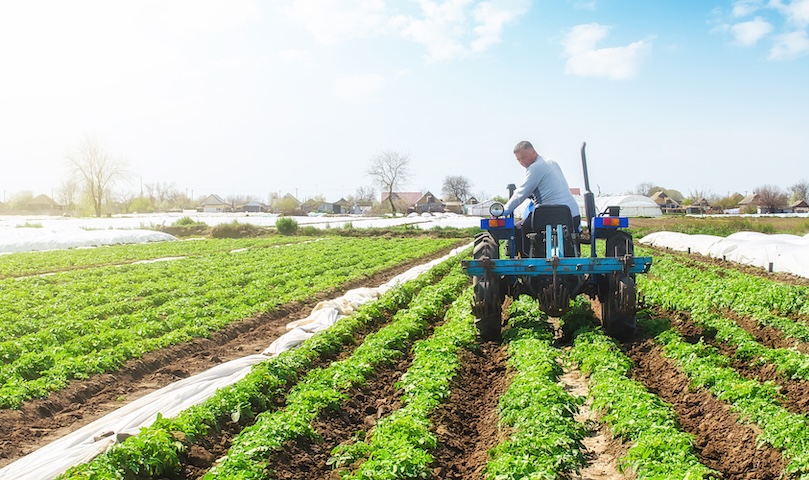
August at any farmstand offers a vision of abundance: stacks of peaches and melons, tables strewn with misshapen heirloom tomatoes, oceans of okra and shell peas and summer squashes — locally grown, meant to be locally eaten. What a visitor likely takes for granted is the inevitability of this scenario, his ability to return to load up on nutritious produce week after week until the snows come.
In reality, farming is a tenuous business, especially for those just starting out and/or determined to raise food for communities of people rather than commodity crops for livestock or biofuel. In 2025 alone, 15,000 farms and ranches across the U.S. went out of business or consolidated with larger operations, with small farms making up the bulk of the closures; 2.5 million acres of farmland were lost overall, according to the U.S. Department of Agriculture (USDA). This wasn’t an isolated series of incidents or an anomalous year. We’ve been losing farmland at a rapid clip for decades.
2.5 million
acres of U.S. farmland were lost in 2025.
More recently, there’s been another hurdle to farmers getting into or staying in business: the uptick in farmland purchases by corporate interests — institutional investors, pension funds, private equity firms. Especially since the financial crisis of 2008, they’ve “increasingly seen farmland as a stable and appreciable asset to invest in, and it has created this frenzy for buying up farmland,” says Austin Bryniarski, government relations coordinator with the National Family Farm Coalition (NFFC). “They can pay top dollar for some of the best quality land in ways that then drive up prices across the entire farmland market.” (As of this writing, the average cost of an acre of farmland just hit $6,000 although, depending on the state, costs can be much higher; many smaller-scale farmers are forced to lease, which comes with its own slew of problems.) The result is farmland that’s too expensive for actual farmers to buy — and a country that John Peck, executive director of nonprofit Family Farm Defenders, says has become a “food deficit country because we have so few farmers left actually able to grow food for us. We need land reform.”
Farmland for Farmers Act
Back in 2023, 71 farmer and rural advocacy groups (including Family Farm Defenders) started lobbying hard for what they saw as a potential solution. This was a bill called the Farmland for Farmers Act, which was introduced in the Senate by New Jersey’s Cory Booker and in the House by Hawai`i’s Jill Tokuda. Noting that the cost of farmland has doubled since 2005, thanks in part to large corporate investors more interested in short-term profits than land conservation to benefit communities, the bill calls for a ban on the sale of farmland to anyone not “actively engaged in farming.” It also excludes corporate buyers who lease land to farmers because, Bryniarski says, they tend not to care about pesticides’ negative impacts on soil and water; and because such leasing drives up rents “for folks in a range of different farming arrangements,” he says. The bill, if passed, might go further in addressing the land crisis affecting farmers than the spate of state bans on foreign ownership of farmland, which critics have called “xenophobic” for their emphasis on China (despite the reality that Canada is in fact the largest foreign owner of U.S. farmland).
A report that NFFC released with the Federation of Southern Cooperatives identified Bill Gates and the Church of Jesus Christ of Latter-day Saints (also known as the Mormon Church) as some of the largest corporate holders of land in the Mississippi Delta region, which is known for rice, sweet potatoes and small grains. But one of the largest farmland holders in the country and the world is the financial services company TIAA, which buys up farmland through its Nuveen investment arm. Bryniarski calls TIAA “a worst offender.” It’s been linked, for example, to deforestation in Brazil, even after a 2018 pledge to end it.
Several states have enacted bans on corporate ownership of farmland, but how effective they are is unknown; a ban voted into existence in South Dakota was deemed unconstitutional by the courts and overturned. Peck is bearish on the possibility of a federal ban; the Farmland for Farmers Act is not currently scheduled to be heard in either the House or the Senate, and he says the likelihood of its language making it into the Farm Bill is similarly slim.
Regardless, should the unexpected occur, “I’m not sure there would be an overnight change, and this is only a piece of a pretty complicated puzzle,” Bryniarski says. “But in implementing this kind of restriction, hopefully the lack of new speculative activity in the farmland market would push the brakes a little bit on what we’ve seen as a constant drumbeat in the prices, and that would be an insurance policy for future farmland purchasers.”
Reality on the ground
The bill sounds good on paper. Hannah Breckbill’s got some worries.
Breckbill is co-owner of Humble Hands Harvest, a 22-acre worker-owned cooperative farm in Decorah, Iowa, that raises organic vegetables and sheep. Back in 2014, when she was just starting out, the land she now occupies was a conventional corn operation whose owners were looking to sell. But, Breckbill says, “The neighbor up the road was concerned about who would buy it if it went to auction. Because land prices are high, the people who have the money are mostly hog confinement operators, or a local mining corporation that would just dig big holes in the ground — neither of those is really great for the neighborhood, or for the health of people in the neighborhood.”
Instead, one community member formed an LLC with another 15 or 20 people to collectively purchase the land for $5,500 an acre, “which was a good deal then and is an amazing deal now,” says Breckbill. “I was renting land at the time and I said, ‘Wow, this piece of land could be a diversified farm; how can we make that happen?’” Bit by bit over the course of years, whenever she and her co-farmer had the cash, Breckbill would buy people’s shares until they finally owned all the land outright in 2022. To her, the importance of a farmer’s ability to stop leasing is straightforward: Leasing, she says, “decreases the amount of investment that the farmer is willing to put into their soil and water and the health of the land. What we really need in Iowa right now is farmers who are taking care of our soil and water quality, because Iowa has some of the highest cancer rates” that have been linked to its industrial agricultural practices.
Farmland for farmers. I do believe those words, but the way to get there is a big question.
Off the farm, Breckbill works as a land access navigator, consulting beginner farms on the very same challenges she faced when purchasing land, which she calls “super frustrating for all of us who want a better food system and better land management.” Realizing some big changes need to happen, she’s supportive of the Farmland for Farmers Act. But there’s a big question mark for her in its definition of the sort of “authorized legal entity” that would be allowed to purchase farmland: It requires that partners be actual farmers — which the members of the LLC she purchased her land from were not. (Although, according to John Peck, even owning a horse qualifies a person as a farmer under USDA rules.) “We recognize that farmers forced into these kinds of work-arounds in the present political and economic environment surrounding farmland may be unexpectedly impacted by the changes the Farmers for Farmland Act would present,” Bryniarski says. But land access organizations “believe that some of the administrative challenges the bill might pose in the short term do not outweigh the long-term objectives and vision of the bill and their desire to support it.”
At the moment, Breckbill is working to figure out a replicable model for community control over its farmland. What she’s hit upon is the Farmers Land Investment Cooperative, an entity that buys farmland with member money, expressly for the purpose of selling or renting it to farmers. Would that be permissible under the Farmland for Farmers Act? Breckbill is still not sure — although the language of the bill makes it seem like it would be. Nevertheless, “Farmland for farmers. I do believe those words,” Breckbill says. “But the way to get there is a big question.”
Related Posts
 Public Health, The Industrial Food System
Ticks, cyclospora, screwworm: Farmworkers are at risk
September 3, 2026
Farmworkers face daily exposure to parasites, pathogens, pesticides and other hazards, yet their health is often overlooked in broader public-health conversations — even as climate change intensifies these risks.
 GMOs & Pesticides, The Industrial Food System
Greenhushing: Climate silence doesn’t mean inaction
August 19, 2026
Has the food sector abandoned their sustainability commitments? We examine the rise of greenhushing and why the silence may not mean companies have given up.
 GMOs & Pesticides, The Industrial Food System
Where has all the soy milk gone?
August 6, 2026
Soy misconceptions have lingered for decades, partially shaped by growing anxiety over ultraprocessed foods. But what is the real impact of soy on our health and the planet?