


Will the pesticides in this bowl of Driscoll’s strawberries kill me?
Trying to make sense of conflicting claims about pesticides? Learn what science says about personal exposure and why the impacts of pesticides go beyond what’s on your own plate.
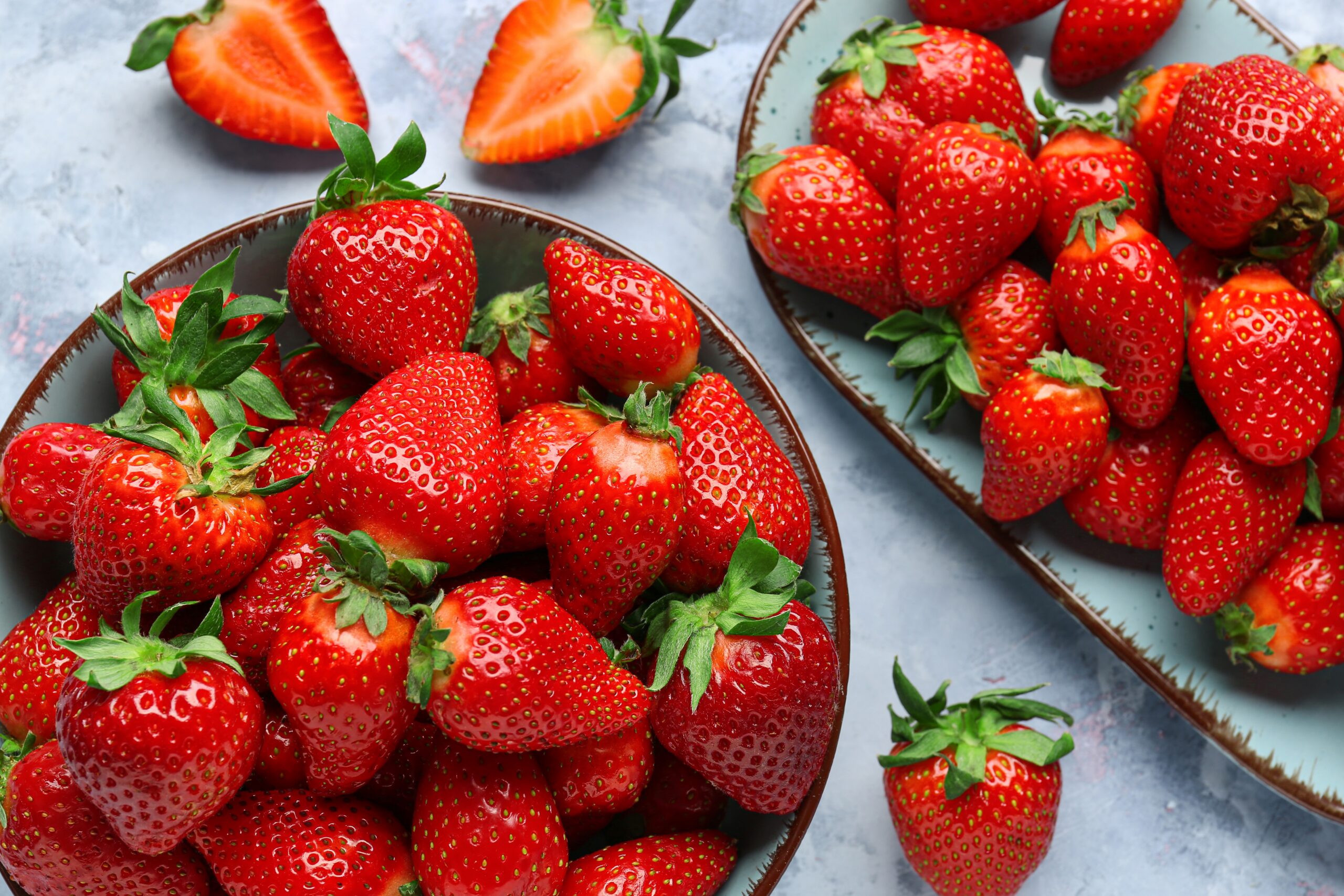
Recently, Mamavation, a wellness site directed to mothers, shared results of a test they did on strawberries, with the headline: “Mamavation’s Laboratory Finds PFAS-laden Pesticides in Driscoll’s Strawberries.” The news, and accompanying panic, spread very quickly on social media. They had contracted with a lab to test two boxes of strawberries: one certified organic and one conventional (i.e., grown with pesticides). The conventional box showed residues of 12 pesticides, including some containing PFAS, while the organic box showed none. Many parents announced they would throw out their strawberries and never buy from Driscoll’s again. After all, strawberries are supposed to be healthy, and parents feed a lot of them to their kids. In some cases, a WHOLE lot.

It’s not the first time a food company has been dragged on social media for being unhealthy or problematic (see our piece on Vital Farms eggs and Kerrygold butter), and it’s not the first time we have seen a mix of fact and fiction in both the initial drag and the follow-up discourse. We’re here to help you make sense of it all.
Do strawberries have pesticide residues?
You’ve probably read about pesticides and strawberries before. Because the berries grow right at the level of the moist soil they need to thrive, sweet, juicy strawberries are an appealing target for both insects and fungi. To avoid losses and make sure the fruits develop correctly, conventional strawberry growers (those who don’t grow them organically) tend to use a lot of insecticides and fungicides. Many of those pesticides leave small levels of residue on the fruit even after it’s been picked and washed.
For many years, consumer safety organizations like Consumer Reports and The Environmental Working Group (EWG) have tracked the different kinds and amounts of pesticide residues on produce. The most widely known, the EWG’s “Dirty Dozen” list, almost always features strawberries near the top.
But how much should you worry about these findings from Mamavation — are they different or worse than what’s customary — and about residues in general?
A number of people responding to the findings on social media pointed out that Mamavation’s methods and results weren’t exactly gold-standard science: Without more detailed explanations of how they ran their analyses, it’s hard to know whether they even tested the berries in a way that accurately captured the residues. They also only sampled one box of conventional berries and compared it to one box of organic, far below the amount you’d need to test to ensure that you got a sample size that’s actually representative of the strawberries we see in the store.
However, even if those tests had been performed more rigorously, there’s the question of how to interpret the results. Mamavation highlighted that many of the sampled pesticides have been banned in other countries, and are linked to a number of health problems. As several voices pointed out in response, the dose makes the poison. In the words of the Unbiased Science podcast, “You would have to eat 123 pounds of strawberries every single day, for the rest of your life, to reach the EPA’s chronic safety threshold for indoxacarb, one of the pesticides they flagged.”
“The dose makes the poison” is one of the central dogmas of modern toxicology. And that’s how the EPA sets its safety standards today: finding the level at which pesticides cause provable harm, then setting limits that are below that level.
But there’s a second, equally important consideration when dealing with potentially dangerous substances: the precautionary principle, which states that “when an activity raises threats of harm to human health or the environment, precautionary measures should be taken even if some cause-and-effect relationships are not fully established scientifically.”
And when it comes to pesticides, there’s reason to believe things might be more complicated than we yet fully understand. In a recent episode of our podcast, “What You’re Eating,” veteran agriculture and pesticide industry reporter Carey Gillam explains that the science of how pesticide residues affect eaters is “evolving, but it’s by no means as robust as traditional toxicology and epidemiology and traditional routes of exposure — through absorbing through your skin or inhaling, which is typically the way that we have looked at pesticide exposures and impacts. So consuming it in drinking water and food, we don’t know a lot about those impacts yet.”
As both the EWG and Consumer Reports detail in their explanations for their methodology, the EPA’s tolerances for residues don’t account for every kind of risk that pesticides might present, like the lifetime effect of exposure to multiple residues across an entire diet. And while the agency is supposed to use a generous buffer to calculate potential risks to children and other vulnerable groups, that hasn’t been consistently applied to every chemical. Critics say that’s the result of a pesticide review process that’s overly deferential to companies’ own safety assessments, ones the agency doesn’t have the resources to conduct itself.
As a result, groups like Mamavation, EWG and Consumer Reports set their own limits for safe residue exposure, ones that are often dramatically lower than the EPA’s.
What to do when a favorite food gets flagged
So what should you do when one group flags something as unsafe but the EPA doesn’t?
Ultimately, that depends on the risk in question. When it comes to general food safety, the EPA’s tolerances for pesticide residues are all still well under the threshold where you’d start to see symptoms of pesticide poisoning or other immediate health problems, even if you were to eat quite a lot of food that had those residues.
There are legitimate concerns beyond immediate safety, however. Sites that do independent studies and set their own tolerances tend to be more worried about exposures over a lifetime, or risks to people who are especially vulnerable, like children, the elderly or those on limited diets. If you see a food you or someone in your family eat a lot of in a pesticide exposé report or a list like the Dirty Dozen, you might want to dig a little deeper: The group that put out the report (e.g., EWG or Consumer Reports) may also offer their own recommendations about what to look for when shopping, like buying produce that is USDA Certified Organic where the highest-risk pesticides aren’t used. Consumer Reports, for example, sorts produce options into five different risk levels, and assigns a “proven safe” number of servings per week based on the highest level of caution.
Most of these consumer advocacy sites do push people toward choosing Certified Organic when possible: After all, using no synthetic pesticides is the most precaution-forward approach to limiting chemical exposures. But most stress that you don’t need to stop eating conventionally grown produce if you can’t afford it. After all, varying safety tolerances aside, even the most-sprayed fruits and vegetables are still perfectly safe to eat in moderation, and the benefits of eating any fresh fruits and vegetables almost always outweighs the risks of pesticide exposure through residues. Unless a product is actively being recalled, you don’t need to worry about residues being so high that you should throw away food, something that people online reported doing after reading the Mamavation article.
Still, saying “no need to worry” doesn’t quite tell the whole story
After the Mamavation story hit, many voices on social media provided the evidence-based critiques we outlined above, and dismissed Mamavation’s findings as fearmongering hysteria. While we agree that the tests aren’t a reason to toss perfectly edible strawberries, some usually trustworthy voices did miss a few important considerations, in some cases dismissing real and emerging concerns about pesticides.
While Unbiased Science did correctly identify the dosing problem with Mamavation’s findings, they also criticized the report’s language about “PFAS pesticides,” stating they are “not a real scientific category” and that they “took any pesticide containing a fluorine atom, relabeled it a ‘forever pesticide,’ and slapped the entire PFAS health scare onto it. They even claim these pesticides build up in your body, but offer no evidence for it, which is the whole reason real PFAS are a concern.”
PFAS pesticides might not be the most accurate umbrella term, but there is a growing number of fluorinated pesticides that, per the most widely accepted definition of PFAS, do qualify. Because their chemical structure is a little different from the most dangerous PFAS, such as PFOA and PFOS, experts say they likely aren’t quite as hazardous to our health. But they also aren’t as well studied, and the main quality that makes PFAS so tenacious in our bodies and in the environment — a strong resistance to natural breakdown — is still a concern to take seriously.
Widening the aperture — the chain of harm of pesticides
You might say, “But I have heard that pesticides cause cancer! Haven’t several pesticide companies had to pay out settlements to users who got cancer?” That’s correct. In every case, however, the plaintiffs were people who apply/work with those pesticides, such as farmers and landscape gardeners. And that — the failure to consider workers — was the real omission in both Mamavation’s post and the responses to it. As we’ve covered on FoodPrint before, it’s en vogue for people to argue there’s no difference between conventional and organic for eaters. But that’s just not the case for workers and the people who live near farms where pesticides are used.
We were happy to see Unbiased Science amend their initial post caption to include a consideration that goes beyond personal harm, pointing out that Driscoll’s has had major labor issues over the years (there’s a good deep dive here). A growing body of evidence points to the fact that farmers and farmworkers have higher rates of cancer, Parkinson’s and other diseases. Pesticides are also implicated in the widespread death of pollinators and other insects.
As toxicologist and FoodPrint science advisor Dr. Urvashi Rangan explains in our podcast episode, “We tend to go around this world these days like, ‘What’s gonna harm me?’ And maybe, ‘What’s gonna harm my child?’ And those are the only two things I’m going to think about, so I care about residues, maybe, at the end. And that is not wrong, necessarily. However, it is just a subset of what the big picture is.”
In our opinion, this alone is a terrific reason to buy organic food: supporting a system in which farmworkers and habitats are safe from pesticides and not put in harm’s way in the name of “perfect” produce. To learn more about the court cases against pesticide companies, and better understand what harms pesticides present and to whom, check out our podcast episode called “Pesticides: Profits vs. People.”
Key takeaways
- Mamavation’s alarm over pesticide residues on Driscoll’s strawberries was based on non–peer-reviewed lab results from just a few batches of strawberries; it isn’t substantial enough to draw broad conclusions.
- It is true, though, that conventionally grown strawberries are known for having a lot of pesticide residues on them. The amounts found are typically lower than regulatory safety limits, but scientists are still studying the long-term effects of repeated, low-level exposures to pesticides from a combination of foods.
- However, it’s important to remember that the biggest pesticide risks aren’t always on your own plate. Farmworkers who work with pesticides, communities around farms, pollinators and ecosystems are often those most impacted by pesticide use.
- If you’re concerned about pesticides, buy Certified Organic produce when you can. Choosing organic food can not only reduce your own exposure to synthetic pesticides but also support farming practices that protect workers and the environment.
Related Posts
 GMOs & Pesticides, The Industrial Food System
Greenhushing: Climate silence doesn’t mean inaction
August 19, 2026
Has the food sector abandoned their sustainability commitments? We examine the rise of greenhushing and why the silence may not mean companies have given up.
 GMOs & Pesticides, The Industrial Food System
Where has all the soy milk gone?
August 6, 2026
Soy misconceptions have lingered for decades, partially shaped by growing anxiety over ultraprocessed foods. But what is the real impact of soy on our health and the planet?
 GMOs & Pesticides
What can Monsanto’s history tell us about Bayer’s handling of Roundup litigation?
June 23, 2026
In this interview, “Seed Money” author Bart Elmore explores Monsanto’s legacy and what it can teach us about Bayer’s handling of Roundup lawsuits and corporate accountability in general.