


What can Monsanto’s history tell us about Bayer’s handling of Roundup litigation?
In this interview, “Seed Money” author Bart Elmore explores Monsanto’s legacy and what it can teach us about Bayer’s handling of Roundup lawsuits and corporate accountability in general.
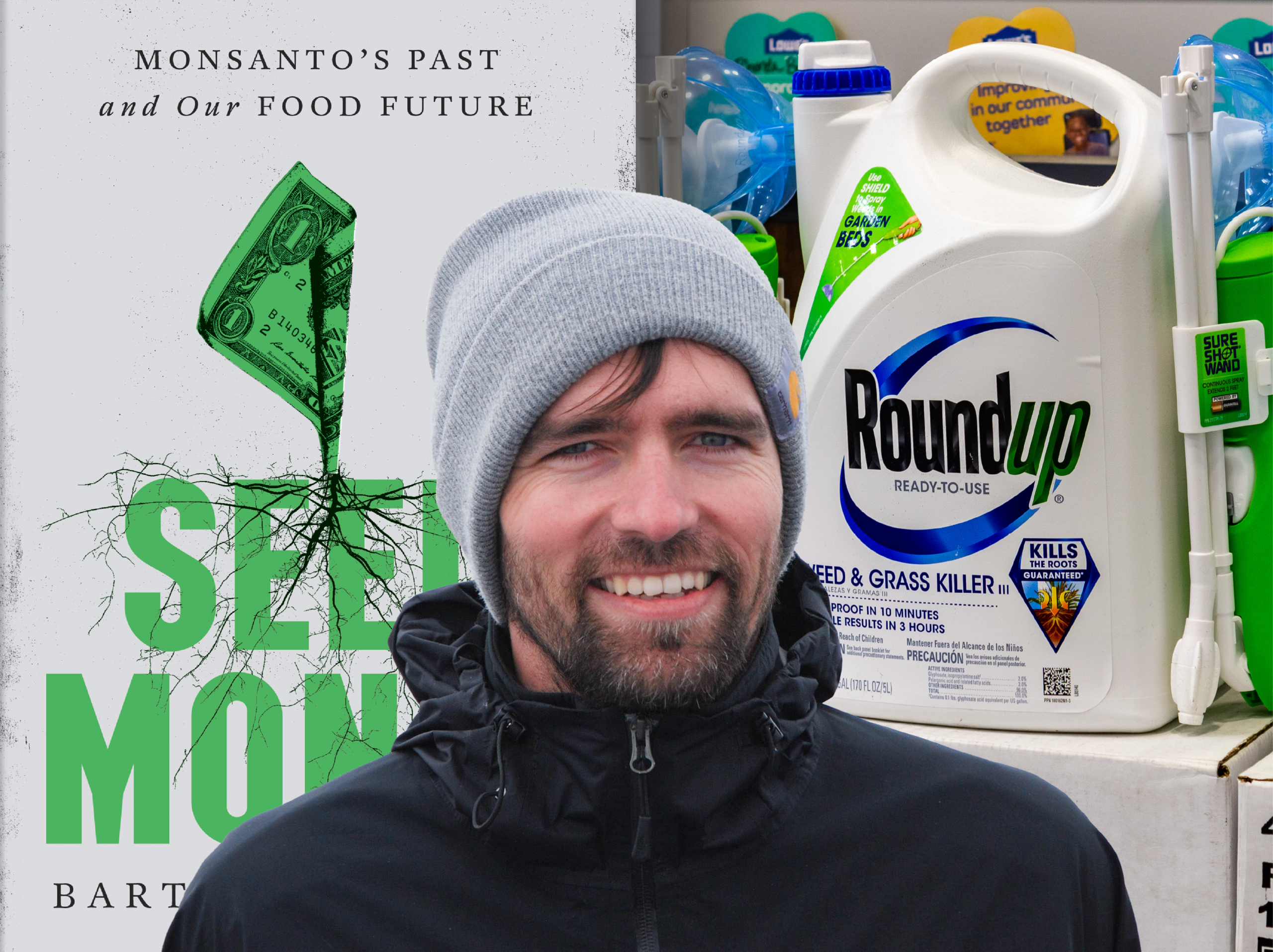
Editor’s note: On June 25, 2026, the U.S. Supreme Court issued a 7–2 ruling rejecting John Durnell’s lawsuit against Bayer (owner of Monsanto) alleging that his exposure to Roundup caused his non-Hodgkin lymphoma. Although this conversation took place before that decision was announced, it provides important historical context on Monsanto and the legacy that continues to shape debates over Roundup and pesticide regulation today.
I first met Bart Elmore when I interviewed him for our podcast episode about sugary drinks. We were there to discuss his excellent book “Citizen Coke: The Making of Coca-Cola Capitalism,” and from him I learned that Coke, in its early days, was using the chemical saccharine to help sweeten its drinks. That chemical was made by a brand new, small, U.S.-based chemical company called Monsanto.
As I learned in Elmore’s next book, “Seed Money: Monsanto’s Past and Our Food Future,” that small company, bolstered by Coca-Cola money, went on to create and sell a host of chemicals — including 2,4,5-T, the main ingredient in the pesticide that came to be known as Agent Orange, and toxic PCBs, which were used in everything from electrical equipment to paint and copy paper. These and others left a trail of health problems and environmental destruction in their wake that resulted in many lawsuits against Monsanto.


More recently, Monsanto, purchased in 2018 by German chemical company Bayer, has been embroiled in lawsuits concerning its pesticide Roundup, which hundreds of plaintiffs say caused their cancer. One of those cases, Monsanto v. Durnell, has risen all the way to the Supreme Court, where a decision is expected any day now. The case centers on the claim that the company had failed to warn Missouri Roundup user John Durnell and other users that its pesticide Roundup (which uses glyphosate as its active ingredient) could cause cancer. Monsanto argues that since the EPA at the federal level had not found Roundup to be carcinogenic, that would preempt the state of Missouri’s assertion that the product should have carried a warning label.
Concurrently with this case’s ascent to the highest courts, the company has been involved in the creation of state-level preemption bills (also known as Bayer bills), has tried unsuccessfully to get preemption language into the most recent federal farm bill, and even offered a settlement to plaintiffs that would keep them from any further litigation.
I interviewed Elmore to get some insight into how this case might turn out.
FoodPrint: Nobody really knows what the verdict in this particular case will be, but I felt like I understood a lot more who the fight was against by going so deep with your book. What do you make of them fighting this case in this way from so many different sides?
Bart Elmore: I think it’s worth noting that Roundup in some ways was seen as a solution to a larger herbicide problem, which was the 2,4,5-T, the 2,4-D chemicals. The idea was that Roundup was supposed to be an environmentally more friendly herbicide. Which requires us to go back to that period when it comes out in the ’70s, because that was right after the Vietnam War. That was right after, as you read in the book, this story of blowing the whistle on the dioxin, this contaminant that was found in one of the blockbuster herbicides that Monsanto, among other pesticide producers, was making, which was 2,4,5-T. Monsanto’s version of 2,4,5-T was particularly high in dioxin concentrations.
It was seen as this amazing kind of weed killer. But, you know, we didn’t just spray it in Vietnam. We sprayed it here in the U.S. and it was used all over the place. Until by the ’60s, we knew, wow, there were really some serious problems with this. I would argue that Monsanto knew that there were problems with this going back to the ’40s, because I went inside their factories where they made this stuff.
We really need to spend more time when we’re thinking about whether these compounds and chemicals should be used in domestic spaces or in military theaters, what’s happening in the factory? And if you do go back as early as 1949, you can see that people were experiencing chloracne, these massive acne outbreaks where there was literally, like, chlorinated chemicals coming out of their skin. It was just a terrible story. But that knowledge didn’t really reach the public, of the potential dangers of dioxin.
Vietnam takes off and there’s a lot of concern about Agent Orange usage during the war, and then boom, there’s this explosive kind of reveal of “Wow, this stuff is really gnarly.” And ultimately, the U.S. military would say, “We’re not gonna use this.” There was to be this huge effort to try and clean up all the dioxin. Of course, that is still ongoing in Vietnam today.
But that is the moment when glyphosate emerges. And this is a long windup to say, How does this relate to Durnell? I was watching this court case of all these people trying to fight for some form of justice because they believe that their exposure to glyphosate was causing these health outcomes, and it reminded me so much of these Nitro workers [Monsanto workers in Nitro, West Virginia] who had done just the same thing, you know? The people who worked in West Virginia in these factories inside Monsanto’s 2,4,5-T plants filed suit against Monsanto, and they could show from medical records that they had been clearly harmed by this.
But they lost that case, uh, on a technicality that West Virginia had that you had to prove that it was willful, wanton and reckless behavior that Monsanto engaged in. And ultimately the jury said that, like, that was a very difficult legal bar for them to prove, and they ultimately did not find in favor of the workers who were exposed to 2,4,5-T.
One thing that struck me is just the failure of tort litigation, you know? So I guess what I’m saying is: Yes, I think that if the Supreme Court were to intervene here and fundamentally prevent people from having their rights to sue in court over things that could potentially cause dangerous cancer that kills them, um, I think that’s a really problematic thing.
We have a court system for a reason so that regular people, farmers and otherwise, can go in and adjudicate this among a jury of their peers. But I also feel like what the Nitro story tells me is that some of those people were already dead by the time this goes to trial. We live in a country in which I think tort litigation is a kind of last resort to hold companies accountable, and oftentimes it can change corporate behavior, but often after the damage is already done, you know?
It seems like the courts are the last vestige we have in America today to try and fight back against things that are deeply problematic, and corporate powers that have just tremendous assets to do what they wanna do. And yet I just wonder in these chemical stories, is this really the best method of remediating these problems?
Because what we really need is to step in before the chemicals are out there causing the harm in the first place. But that requires a commitment and a willingness to engage in regulation, and developing federal regulation that could prevent these things from being out there in the first place, and I don’t see that kind of legislation emerging in the kind of Congress that we have now.
FoodPrint: You know, a lot of people think of Monsanto now as a seed company or an agricultural company, but I learned from your book that its roots are as a chemical company.
Elmore: In 1901, Monsanto is founded by a guy named John Queeny. You know, he is an entrepreneur in every sense of the word. He’s somebody who wants to kind of make it on his own. He doesn’t know chemistry very well, which I think is so important to point out.
At that time, this was the heyday of organic chemistry. Germany and the Europeans were not just in the lead, but they were kicking butt and taking names, you know? You had a bunch of companies that were taking the lead on how you can make chemicals, specifically from fossil fuels. Initially from the waste products of the coal industry, from coal tar, finding that you could take these carbon-based compounds and turn them into all sorts of things, including aspirin, you know, which Bayer became famous for in the early 1900s.
The American chemical industry was so far behind and Monsanto in some ways was a, you could argue, was like an effort at liberation. It was an attempt to create an American producer of chemicals that could compete with these bigger giants overseas. Initially, he started in what was called specialty chemicals, so they were selling chemicals that were for very specific clients and for specific purposes, and their biggest client initially was Coca-Cola.
And then two wars — World War I, World War II — hit, and you had this disruption of international trade. The U.S. government needs chemicals, and they funnel a lot of money and contracts towards companies like Monsanto. And I always teach this in my classes as the dawn of the synthetic age, where everything now is gonna be made via not just coal tar, but now we’re finding ways to use the byproducts of oil refining. And, one of the big markets that they saw was agriculture. By the ’40s, wow, you could create petrochemical pesticides that could be sprayed over millions of acres.
FoodPrint: I was struck that, since the very beginning, things were not regulated. It was the Wild West. Sometimes they didn’t know what the impacts were of these chemicals. But they also seemed to be deeply uninterested in finding out. As a result, your book ends up also being a chronicle of the many times over the years they have gotten sued.
Elmore: When the initial Roundup cases hit, when the Dwayne Johnson case hit in 2018 [the first Roundup suit against Monsanto], I was still writing this book, and I just remember being like, “Well, here we go again.” But let’s remember when that merger happened, when Bayer bought Monsanto in 2018, it was worth about $120 billion. That was its market cap. And I think within a matter of six months, it might have been nine months, I watched that value of the company go from $120 billion to about $60 billion.
Because those cases hit back to back to back. The Dwayne Johnson case, the first case where it was a gardener out in California who claimed that his exposure to glyphosate led to his non-Hodgkin lymphoma. And that the jury found that there was enough evidence to find in favor of the plaintiff. There were two others that followed that after, the Halderman case and a couple others, and I just remember watching that stock and I thought, “Wow. Maybe this is the reckoning that never came in the rest of the book.” Whether it be Agent Orange or PCBs or all the other stuff they produced that were everywhere, and where they had huge liability because they were one of the largest producers oftentimes of these chemicals.
I was meeting with the company during that period because of the strange situation after my book came out, where some people inside the company, who I believe were extremely well-meaning, reached out and said, “Hey, we’re really struggling with this Monsanto company that we bought, and we’d like to talk and kind of think through what are the best and ethical ways to move forward?”
This long-term issue of how do we protect ourselves from harmful chemicals, I think the answer is you gotta do it up front. You have to have a precautionary principle. You have to step in earlier. You cannot release these things with a fairly elementary understanding of exactly how that’s gonna affect the broader ecology. And I get that that’s a challenge, and businesses are struck with this because they say, “Well, we wanna get it out there, but it’s infinitely complex what the ecological impacts could be.” Well, that’s the problem, you know? It’s why you shouldn’t introduce something that does that.
But in these meetings I’ve had with people inside the company, I can tell you they wrestle with these things, you know? I’ve even had pointed conversations specifically with senior vice presidents of the company and said, “What if you’re wrong about glyphosate?”
This is the most popular herbicide in world history. It has spread across the globe. And, you know, these individuals are in a position where they could raise their voice. Even if you say, “Uh, I’m not certain that it caused non-Hodgkin lymphoma” — okay, fair. If that’s your view, that can be a view. But what about all the other potential implications of this glyphosate? What if it does cause non-Hodgkin lymphoma? Just “what if you’re wrong?” is all I’ve been trying to get folks inside the company to think about.
Now, I think if you had those people on your podcast today and they were to say they had their chance to air their feelings, they would say, “Look, this has been vetted. The EPA has looked at this. The European Food and Safety Authority has looked at this and have given it a clean bill of health.” But there’s a lot of debate and discussions about what studies these people relied upon. We now know that many of those studies were ghostwritten in many cases. Those studies that became kind of gold standard studies, cited on Wikipedia, cited in public reports.
The last thing I’ll say and be very clear: In this book, I did not try to take a scientific stand on “glyphosate causes X.” I am not a medical doctor, and I’m not somebody who can say that, and I wanna be so clear about that. But I will tell you, as a historian who read a lot of the scientific literature and who read about the ways in which a lot of the scientific studies had been influenced by Monsanto, that does not inspire confidence, you know?
I don’t know where we’re gonna land on what glyphosate’s effects are, and the certainty that people seem to suggest there is inside the company because they believe there’s so many studies that are out there that say it’s safe, while I’m also reading all these studies that are raising questions about the microbiome and other things in big publications like Nature.
That’s what keeps me up at night, you know? That’s what bothers me, is that that doesn’t seem to be the right way to go about things. When there are clearly good questions being raised, we probably wanna be much more precautionary about how we’re using something like glyphosate.
If we only see these stories in history as bad people doing bad things, then we really don’t learn anything. And so I’m trying to understand their perspectives. But it’s startling. I kind of hoped that Bayer was gonna take a really big, different pivot and I made that case in front of Bayer people. I said, “Look, you have an opportunity here, I think early in this merger, to show the world that you’re something different than the old Monsanto.”
FoodPrint: You talked about those conversations both here and abroad where farmers were addressed by these Roundup salespeople saying, “This is the future, it’s inevitable, and you must get with it.” And I think that’s one of the narratives that was really pushed on farmers. But of course, also it was this promise of more yield, and this is a narrative that still sticks with chemical-intensive industrial agriculture now, which is, “We need this because of its higher yields, because we need to feed the world.” Is this even true?
Elmore: Bob Shapiro, who was the CEO of the company in the 1990s, was very specific. He promised that this company was going to start selling these really smart, genetically engineered crops that were gonna make chemical dependency a thing of the past, that the whole point was you’re gonna embed this new genetic information like software, and it would make them sharper and smarter, and then you’re going to need less resources.
And so that’s what happened. Initially, you saw this dive in the amount of chemicals farmers needed to use because they essentially could use glyphosate and kill most of the weeds. But over time, because they were using glyphosate almost exclusively on their Roundup Ready genetically engineered crops, you started seeing weeds develop resistance to Roundup, and so they had to go back to old chemistry.
So much so that now you have a tremendous amount of glyphosate being used on soybean farms and corn farms across the country, and on top of that, a cocktail of all sorts of other herbicides from dicamba to 2,4-D, yes, going back to that old chemistry to try and beat back weeds that have developed resistance to Roundup.
So Shapiro’s promise was wrong. We can now look at the data and say, “No, soybean and corn farmers are not using less herbicide. They’re using more. And not getting rid of the old herbicides. They’re having to use that again.” And then on the yield, the whole argument was that, well, this is about feeding the world.
But we saw through some excellent reporting in 2016 and 2017, the data was very clear that if you looked at conventionally bred crops that did not have the genetically engineered traits in them, grown in very similar circumstances and environments where you’re trying to control for kind of various factors, the yield trends for growth were the same as genetically engineered crops.
What it did do was it made it easier for many farmers, in the short term, to grow their crops because you didn’t have to weed as much or spot check and do all sorts of things, and you could do a much more mechanized form of agriculture. But in the long run, farmers I’ve talked to are frustrated because now you have weed resistance, that simple system is becoming much more costly. They’re having to use a lot more herbicides. They’re having to do a lot more stuff on the farm and field. So it’s kind of like a rat race where they’re constantly trying to keep up, and put out more chemicals to deal with all this.
And anybody looking at this with eyes wide open can see it’s broken, that is not the way we’re gonna sustain our food production moving forward. What we now know is that the way that these genetically engineered crops were first introduced did not produce the kind of food bounty that I think was promised.
FoodPrint: Well, at the end of your book, you wrote, “It was more about selling chemicals than investing in real solutions to our problems.”
Elmore: Another way I conceptualize it as I had more time to think about it after the book came out was: They were really good problem sellers, not particularly good problem solvers. That is to say, they were really good at framing what the problem was and positioning themselves as the solution. And glyphosate is a great example because you often hear, for example, well, one of the great things about glyphosate is that you have no-till farming, which preserves the soil. But you can still have soil preservation no-till techniques, not necessarily without the Roundup Ready system. You know?
But this is a common strategy of using those big boogeymen of, “There will be famine if we don’t use this,” as a technique of keeping critics at bay. But it’s disingenuous, and it’s just not the full story.
FoodPrint: And they’re using that kind of technique now, with these failure-to-warn cases, saying, “If you are able to win these suits, we won’t be able to sell glyphosate, and you won’t be able to grow food.”
Elmore: So the argument that Bayer would make in these cases again would be, “Look, there’s a bunch of studies out there that say this stuff is safe. All the major regulatory agencies that we care about say that it’s safe. So, we’re just trying to make sure that we’re protecting ourselves legally here.” You could go back to the Agent Orange case and say that Monsanto’s executives did a similar thing then, where they said, “Look, the U.S. military asked for these herbicides from us, and we provided it, we should not be held liable for the fact that Vietnamese citizens are affected by this herbicide.
How does it get complicated when you then learn that the company knew that their workers’ faces were peeling off in 1949 when they were exposed to the chemical, and that the U.S. government didn’t know that?
This is again one of those false arguments I don’t like, which is, well, an agency thinks things are safe. Well, if we now know, and again, we can debate the degree to which the science was manipulated and shaped by Monsanto, but it’s not a question whether they did it. They did do that. We have historical evidence that shows that they did manipulate those studies, that there was conflict of interest that was not revealed.
Related Posts
 GMOs & Pesticides, The Industrial Food System
Greenhushing: Climate silence doesn’t mean inaction
August 19, 2026
Has the food sector abandoned their sustainability commitments? We examine the rise of greenhushing and why the silence may not mean companies have given up.
 GMOs & Pesticides, The Industrial Food System
Where has all the soy milk gone?
August 6, 2026
Soy misconceptions have lingered for decades, partially shaped by growing anxiety over ultraprocessed foods. But what is the real impact of soy on our health and the planet?
 GMOs & Pesticides
Will the pesticides in this bowl of Driscoll’s strawberries kill me?
June 16, 2026
Trying to make sense of conflicting claims about pesticides? Learn what science says about personal exposure and why the impacts of pesticides go beyond what's on your own plate.