


The problem of plastic mulch in organic agriculture
Organic farmers rely on plastic mulch to control weeds, but a change to USDA organic standards could allow biodegradable mulch film if experts can agree on their impacts on soil.
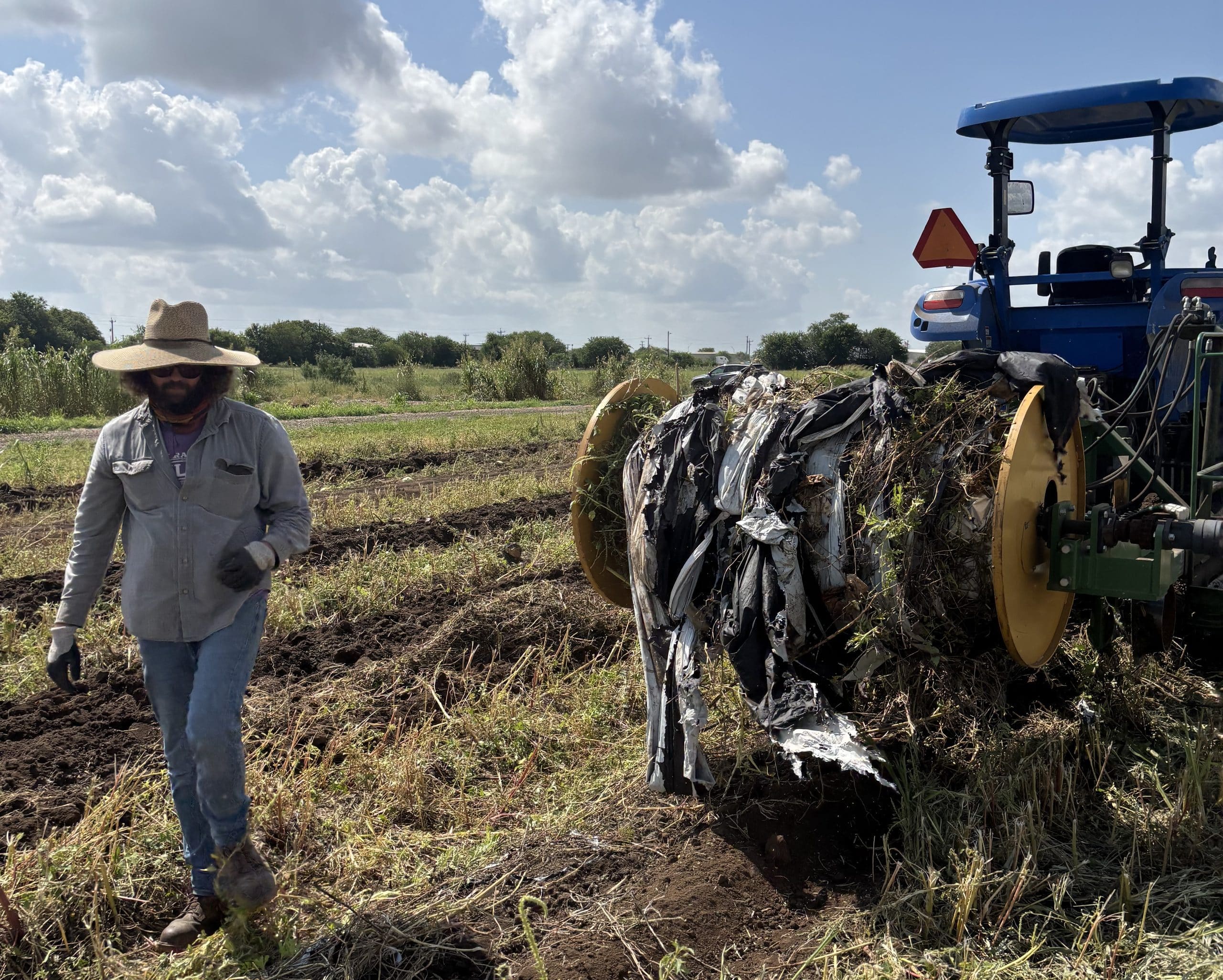
Three people, a tractor and four hours are what it takes on our regenerative farm at the San Antonio Food Bank, in Texas, to pull one acre’s worth of plastic mulch film out of the ground at the end of the season, and we still don’t get it all. Nobody does. Even under the best management practices, 5 to 10 percent of the material stays in the soil.
Our farm, and certified organic farms, don’t use powerful herbicides like Roundup, which has been tied to risks of cancer, kidney damage and other human health harms, as well as environmental consequences. Instead, we find other ways to fight weeds; one of the most common is pulling a thin layer of plastic tightly over the field rows around our crops and burying its edges in soil. Globally, about 2.5 million metric tons of this plastic mulch film goes onto farmland every year. Almost all of it ends up in a landfill, and what doesn’t get hauled away stays in the ground.
But there is another version of this material, biodegradable mulch film, that’s designed to be tilled into the soil and consumed by microbes rather than removed. The United States Department of Agriculture (USDA) has technically allowed this sort of material to be used on organic farms since 2014, but in the last twelve years, no manufacturer has ever fully met the USDA’s standards. In a 2023 memo, the head of the National Organic Program stated that no known biodegradable mulch film meets the requirements of the current regulatory listing — making it “allowed, but not actually useable.” The challenge comes from whether the film’s materials are biobased (sourced from living things) or made from petroleum, and whether or not they actually biodegrade (get fully digested by soil microbes) or if they just disintegrate into smaller and smaller plastic pieces.
The problem with plastic mulch
Mulch does three things: It holds moisture, moderates soil temperature and blocks weeds from germinating. Natural mulch, like wood chips and straw, leave gaps for weeds to poke through, and reapplying it year after year can change the soil’s chemistry. Plastic mulch film is different. It can quickly create an impermeable barrier that works much better at preventing weeds than simpler alternatives do.
The trouble comes at the end of the season. After months of sun, wind, irrigation and traffic from people and animals, the plastic film is brittle and full of tears. Pulling it up is slow and messy, since it comes off the field carrying soil, roots and vines. That contamination means 30 to 80 percent of the plastic that is removed can’t be recycled. Rather than paying to haul it to a landfill, many growers report burning it, even though that is generally illegal.
One Straw Farm in Maryland, certified organic since 1986, switched to a film they believed was biodegradable in 2009; in 2012, they were told by the National Organic Standards Board (NOSB) that it wasn’t allowed. The farmers, Drew and Joan Norman, opted to give up their organic certification rather than go back to plastic, losing an estimated $100,000 in sales that year. Those losses were too steep, however, and today the Normans’ farm is certified organic again, using conventional plastic mulch and landfilling it.
Plastic mulch has been on American farms since the 1960s, and the disposal problem arrived with it. In 1991, though, the first film marketed as biodegradable, called Mater-Bi, became commercially available. Over the years, its formulations improved and broke down better and better. These products biodegrade, but the United States federal government has never permitted them on organic farms.
Since 2012, NOSB has required two criteria that keep current biodegradable mulches from qualifying for the Organic List. First, the materials have to be 100-percent “biobased,” a term that describes where the material’s carbon originated. Second, the material has to demonstrate 90-percent biodegradation in soil within two years, measured in a laboratory test.
Because of these two requirements, there is no legal biodegradable mulch film on the market in the United States.
The trouble with “biobased”
There’s debate over whether the biobased requirement is helpful, but that is ultimately a separate question from whether a material is biodegradable. As Steve Ela, a fourth-generation fruit grower in Colorado who served on the NOSB from 2017 to 2022, said, “You can make a product from 100-percent biobased material that will last for the next 30 centuries depending on how you adjust the molecules, or one that is made from fossil fuels that will break down overnight.”
Most plastic used for 3D printing, for example, is called PLA and is made from fermented corn sugar, which makes it 100-percent biobased. Still, put a failed print in a compost pile and it will be unchanged in two years because it wasn’t formulated to biodegrade quickly. By contrast, biodegradable surgical stitches used in accredited hospital emergency rooms across the country are often petroleum-derived, but still break down in the body completely within about four months.
Nearly all experts agree that the 100-percent biobased requirement is less important for soil health than biodegradability. But for now, there are far fewer options for biobased plastics than there are synthetic ones, and creating biobased materials that fully biodegrade on the right schedule has been challenging. As tough as those 3D-printed corn plastics are, viable mulch film versions that can hold up for a season without lingering too long afterward don’t seem to be commercially possible yet. The NOSB’s own subcommittee later wrote, “The current listing of biodegradable mulch on the National List is aspirational: there are no products on the market that are commercially viable made from 100% biobased carbon sources.”
In a four-year Washington State University trial of five biodegradable mulch films, the only one that broke down fast enough to meet USDA’s standard was also the one with the least biobased material.
Dr. Carol Miles, who has been testing these films at Washington State University as professor of horticulture since 2003, said, “From a microorganism’s perspective, carbon is carbon is carbon.” To the microbes eating the mulch film, it makes no difference if that carbon comes from corn or petroleum.
The bigger question (and source of debate) is this: What is actually biodegradable?
Biodegradable: An elusive definition
When plastic breaks down, it can fracture into smaller and smaller particles that remain plastic, or it can be consumed by microbes and converted into carbon dioxide, water and microbial tissue. Breaking into smaller pieces is “disintegration.” Being processed by microbes is “mineralization,” and it’s that process that scientists use to define whether a plastic is actually biodegradable in the soil. But a plastic can disintegrate without mineralizing, and telling the two processes apart in a field is hard.
“When you dig into the standards, especially with compostable polymers, most only require degradation to 90 percent, and they [farmers] assume that it’s totally broken down,” Ela said. “What happens to that last 10 percent? Does it break down, or become microplastics or nanoplastics? In the organic world, we don’t like those unanswered questions.”
Research on what is happening under the surface is complicated and takes time. It seems that particles from biodegradable films can persist in soil for between two and 10 years, but it is unknown if they hurt the soil in that time.
What happens to that last 10 percent? Does it break down, or become microplastics or nanoplastics? In the organic world, we don’t like those unanswered questions.
A group of independent university researchers who spent four years analyzing the soil health impacts of biodegradable mulch film concluded that biodegradable mulches had no long-term negative effects, looking at water infiltration, soil aggregates, nutrient leaching and microbe activity.
Dr. Douglas Hayes, institute professor at the University of Tennessee who spent years developing and testing these materials, wrote in an email, “There is [sic] enough published scientific results, in my opinion, that the replacement of conventional polyethylene mulch films with biodegradable ones does not promote any harm to soil ecosystems or farming operations over several-year periods, and should be allowed.”
However, different environments can behave very differently, and a rule for organic production from the USDA applies equally everywhere. “Anything the board approves will be used throughout the United States. That is the hard part,” Ela said. “If you put that material in a warm environment with lots of soil activity, it will probably break down, but if you put it somewhere without irrigation or with long winters, it may become a big biocontaminant.” According to Ela and other critics of the currently available films, this inability to say with certainty that a film will biodegrade at least 90 percent in every location and climate is the main obstacle.
Dr. Miles found that the same products in Washington State broke down more slowly than the two-year threshold because of the cold, but much faster on an irrigated farm in warmer Texas.
For some environmentalists, the chance of harm from biodegradable mulch films doesn’t leave any wiggle room. Jay Feldman, executive director of Beyond Pesticides, sat on the board in 2012 when the listing was created and voted against allowing biodegradable mulch films. He hasn’t changed his mind. He said, “Avoidance of landfilling plastic unfortunately cannot be a tradeoff for degradation of organic farm soil.”
How other countries are handling biodegradable films in organic growing
European environmental regulations reached a different conclusion regarding biodegradable plastic mulch. “Europe doesn’t have the biobased standard,” Dr. Miles said. “Instead, products which are certified biodegradable have to be tested to ensure that they actually biodegrade.” Its standard requires 90-percent mineralization in a laboratory soil test, but adds on the extra layers of screening toxicity in earthworms interacting with the materials, and how much nitrogen is leached out.
There are no firm numbers on how widely European farms use these films, but European Bioplastics, the industry association, says certified soil-biodegradable mulch films have been used on European soils for more than twenty years, which has substantially decreased conventional plastic use.
China, the world’s largest user of mulch film, leaves roughly a fifth of what it applies in the ground. Its government recently started subsidizing mulch film they call biodegradable, though farmers report low adoption so far. None of the “biodegradable” films in Europe or China would be allowed on organic farms in the United States.
What growers do to avoid plastic when retaining their organic certification
There are other types of mulch besides films, of course.
Wood chips and straw are usable in gardens and even small farms, but for the massive farms that grow most food, these mulches don’t mix well with field operations. They’re a lot of material to move, and hinder tractor operations like tilling and shaping growing beds.
Cover crops — nonedible plants used to suppress weeds, improve moisture and attract pollinators, among other benefits — can be crimped down to the surface after they grow, which can provide both protection for crops and fertilizer as they break down. Almost 5 percent of all cropland in the U.S. is now using cover crops, but using them as a mulch rather than a soil amendment is rare because there’s not much equipment available to reliably crimp them and they’re not as effective in weed suppression as mulch films or herbicides.
Some farmers are experimenting with covering their rows with paper as a weed barrier. Although paper decomposes quickly, it can tear easily, giving weeds the foothold they need to sprout and crowd out crops.
Farmers may have a brand-new powerful ally in the fight against weeds, however. Automated weeders have made massive strides in the last few years by leveraging artificial intelligence. They can now consistently identify and eliminate weeds around crops, using sprayers, mechanical tools and lasers. Growers have seen 30-percent crop biomass increases with certain products without using any herbicide. At least for now, however, this equipment costs hundreds of thousands of dollars and is out of reach for most farmers.
None of these fully replaces what plastic film does, which is why farmers like me still rely on it, despite our misgivings.
Moving forward
The NOSB will review the rules on biodegradable biobased mulch film again in 2027. They’ll decide what percentage of the films must be biobased, and how to judge their biodegradability.
Steve Ela, who will be writing comments for the National Organic Coalition, said, “Part of the reason for these sunset reviews every five years is to see if there’s new information available. There will be proponents of biodegradable mulch who say it already meets all the standards. Some of us will respond that they meet current standards, but that the standards need to be revised to account for microplastics. We need more field studies.”
At stake are millions of acres of farmland and their soils. Without changes, nearly a billion pounds of plastic will continue to go to landfills annually, along with vast labor from farmers trying to remove them. Since our farm at the food bank doesn’t need to sell certified organic crops, next spring we’ll switch to a version of mulch film that is marketed as biodegradable (but doesn’t meet the organic standards). Like many farmers, we’ll do our own trials in our own fields.
Key takeaways
- In organic agriculture, where chemical pesticides and herbicides are for the most part prohibited, growers usually use plastic mulch film, which prevents the growth of weeds far better than simpler alternatives like wood chips. However, traditional petroleum-based plastic is labor-intensive to pull up, difficult to recycle, and nearly impossible to remove completely.
- Many organic farmers would prefer to use biodegradable plastic mulch. But the USDA prohibits its use on certified organic farms unless the plastic is 100-percent biobased and 90-percent biodegradable within two years.
- There is no plastic mulch currently on the market that meets both of the USDA’s standards for biobased and biodegradable, meaning that an organic farm wishing to use plastic mulch is limited to petroleum-based (plastic) options.
Related Posts
 Sustainable Agriculture
A new book celebrates radicchio, a cold-season stunner
October 20, 2026
Explore radicchio’s rich history, diverse varieties and culinary uses in Lane Selman’s new book celebrating the beloved Italian vegetable.
 Social Justice, Sustainable Agriculture
A new book honors Black contributions to American agriculture
September 23, 2026
Eleventh-generation farmer Michael Carter Jr. talks about his new book “Africulture” and how Africans and their descendants made American agriculture — and America itself.
 Local Food & Farmers Markets, Sustainable Agriculture
Buying better beans: Look beyond the supermarket to find tasty, affordable dried legumes
September 15, 2026
Sourcing dried beans has never been easier as farmers across the country are producing beautiful and flavorful varieties.