


A new book honors Black contributions to American agriculture
Eleventh-generation farmer Michael Carter Jr. talks about his new book “Africulture” and how Africans and their descendants made American agriculture — and America itself.
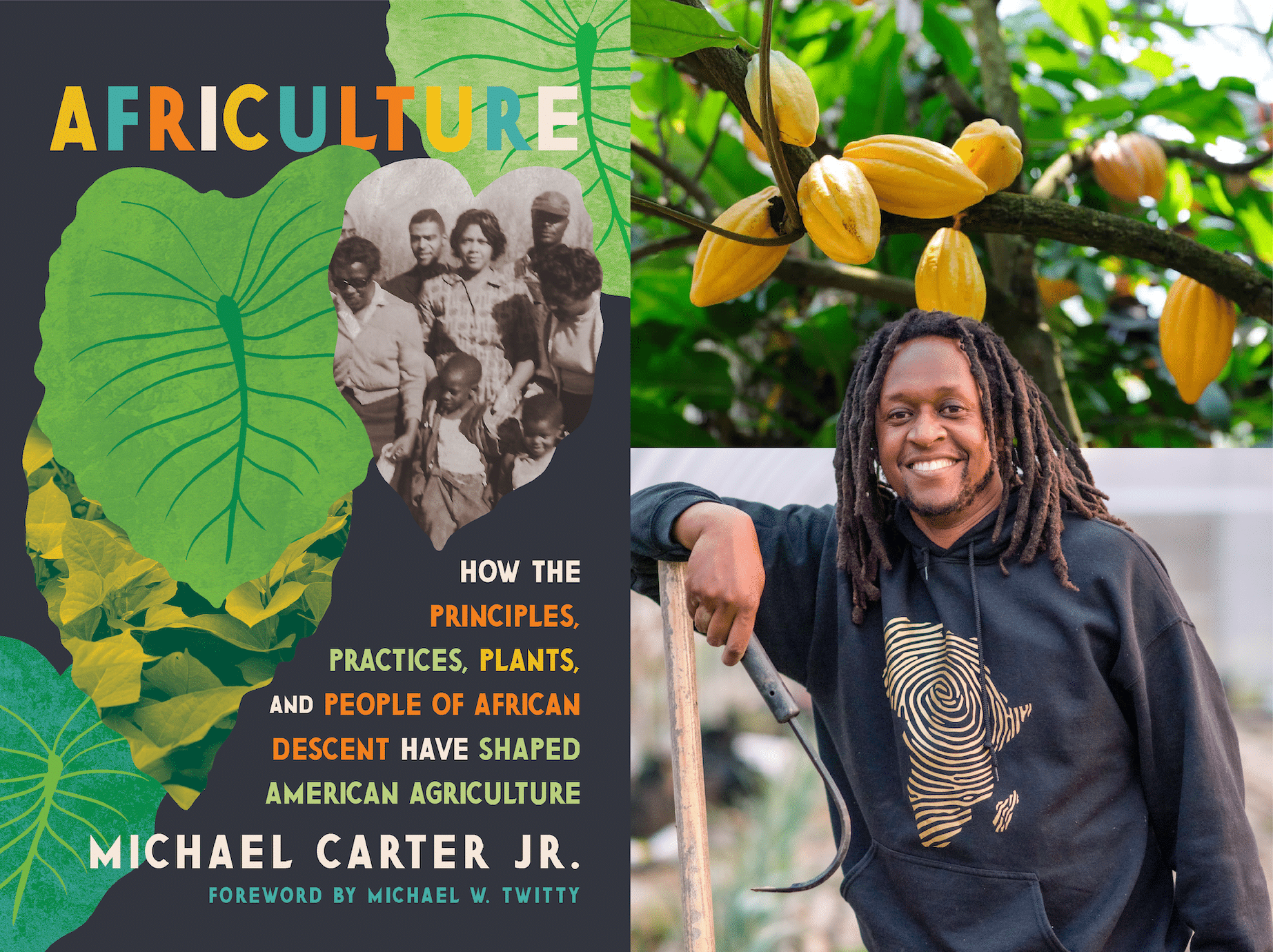
A version of American history is hiding in plain sight on your grocery store shelves, in a can of Coke or a bottle of vanilla extract. Coca-Cola’s flavor traces to the African kola nut. Vanilla became a commodity thanks in part to the ingenuity of a Black man of African descent. Rice and indigo, two cash crops that formed America’s economic foundation, also connect to Africa. But these contributions to American agriculture have been largely overlooked, if not deliberately written out of history. Michael Carter Jr.’s debut book puts them back in.
“Africulture: How the Principles, Practices, Plants, and People of African Descent Have Shaped American Agriculture” draws from Carter’s deep well of knowledge. As an eleventh-generation farmer, he grows African and other warm-season crops organically on his family’s 116-year-old farm in Orange County, Virginia. That land is also home base for his nonprofit, Africulture, where he supports other farmers to “increase their yields, markets and sustainability” and teaches the principles now outlined in his book. He has also worked as an agronomist and organic agricultural consultant in Ghana, Kenya and Israel.
In “Africulture,” Carter weaves his expertise and ancestry together with stories of America’s founding, Virginia’s oldest plantation, Black and Indigenous agricultural innovators, data on the steep decline in Black farmers over the last century and lessons learned from his five years living and working in Ghana, which inspired the book. Cover to cover, he uses the life cycle of crops as a metaphorical thread to stitch all these subjects together.
It’s a lot for one book to hold and that is intentional. “Africulture” doesn’t aim to oversimplify our history, but to show its interconnections and complexities. This feels like a salve for a festering national wound, as the Trump administration scrubs American slavery, Native American history and even climate change from our collective story. The harm of this erasure might be that future generations of eaters fail to see what Carter’s book ultimately shows: How the past set the stage for the present.
FoodPrint caught up with Carter to talk about “Africulture,” a book that he says is for anyone who eats. The interview has been edited for length and clarity.
YOUR BOOK COVERS SO MUCH — HOW WOULD YOU SUMMARIZE IT?
I would summarize the book as the subtitle explains: How the principles, practices, plants, and people of African descent have shaped American agriculture — but through the lens of a humorous, authentic biography of self. The book is about how I see agriculture and the world, and how they’re interconnected. That interconnectedness is what makes the book unique. I tie art, go-go music, protests and my experiences on U Street in Washington, D.C., in the ’90s and early 2000s into a book about agriculture. When you think about go-go music, you don’t think about agriculture, but in my world, we make those links. I’m a tailor of stories and have a gift for using golden thread to always show you connections.
“Africulture” is a book I would have loved to read at 16, when I didn’t know my own culture or family history, and didn’t have a sense of pride in it. But if I’d read that book, I couldn’t have written this one. So much of it centers on me searching for home, exploring different spiritual paths, living different lives, and revering different cultures and individuals.
HOW DID THE FIVE YEARS YOU SPENT LIVING AND WORKING IN GHANA INFLUENCE THE BOOK?
There’s a psychoactive plant in Ghana called voacanga Africana. By the time I tried it, I’d been working there for about three years, teaching agriculture and helping farmers transition from conventional to organic. When I ate the plant, I had finally accepted that the land was gonna teach me something — that I wasn’t just there to teach others.
Once I humbled myself, I started listening, hearing more about nature and what the culture had already been telling me but I wasn’t really absorbing. I was hearing it, but I wasn’t feeling it. I started seeing connections and accepting African cosmology and mythical structure. I started to embrace more of my African knowledge system, and that I could learn something from Ghanaians, just like maybe they learned from me. It became more of an exchange.
When I came back to America, I knew I needed to share the experiences I had in Ghana that helped shape me and create the concept of Africulture.
WHAT IS AFRICULTURE AND HOW IS IT DIFFERENT FROM OTHER CONCEPTS?
What I want Africulture to be is a framework for how we commune with nature and agriculture, recognizing the divinity in nature and the earth, and our relationship with the earth as our strength, our connection, our bond to other humans and the broader spiritual realm.
This earth, this land, this planet we live on, where we gain our sustenance for life, is our everything. The earth is our mother. . . . It’s our home, and we treat it with such disdain. We have measures in place for what we call “conservation,” “environmental studies” or “environmental protection agencies,” and things like that. Indigenous nations of this land didn’t have an Environmental Protection Agency. They had an understanding of the [Seventh Generation Principle]: You don’t do something that will cause harm for seven generations. Now the only thing we think about is how can we get seven figures out of this scenario? This mindset is causing a lot of hurt and pain to the earth. In 100 years, we’ve done more destruction than in the last 3 billion years, and it’s only getting worse because our relationship with our earthly mother has been severed.
What I want Africulture to be is a framework for how we commune with nature and agriculture, recognizing the divinity in nature and the earth, and our relationship with the earth as our strength, our connection, our bond to other humans and the broader spiritual realm.
Africulture desires to help reconnect us. It’s not exclusive to people of African descent, but it does highlight their contributions to many things we take for granted — like chocolate, cocoa, cotton and rice — that came to America [with Africans] or were influenced by Africans who made sure these crops were commercialized, popularized, sanitized for white Western European populations. I’m not gonna allow [African people and their descendants] not to be acknowledged in a manner I feel they should be.
WHAT DOES AFRICULTURE AS A CONCEPT OFFER US FOR THINKING ABOUT SUSTAINABILITY, PARTICULARLY SUSTAINABLE EATING?
Africulture encourages you to grow your own food associated with your ethnotype, phenotype and genotype — which are tied to where your ancestors potentially originated — and make those foods — pulses, proteins or milks — at least 75 percent of your diet.
Africulture encourages you to keep processed foods to a minimum. For the most part, the only processed food I had in my five years in Ghana was spaghetti. When I wanted peanut butter, I would get ground nuts, the equivalent of the American peanut. I would take it to a mill, and they would turn that into peanut butter. Or my staff would go to the market for wheat berries to grind down for cookies, breads and cakes. I lived a sustainable lifestyle there (with the benefits of having an American paycheck) and it was lovely.
Africulture also encourages you to do more with less. In Ghana, I was in villages that were 100-percent sustainable. Yes, the lights may go out occasionally, and you might be living in one room. But four generations of your family live in one village. You’re eating from the land every day. You go and fetch water every day. You’re 75 years old with washboard abs because you work with your hands every single day. You have muscle; you’re very limber and you have good mobility. The one thing you don’t have is a paycheck. But you have everything that you need to be sustainable for yourself.
LET’S TALK ABOUT SUSTAINING FARMERS: GIVEN YOUR HISTORY OF ADVOCATING FOR BUYING DIRECTLY FROM BLACK FARMERS, HAVE YOU BEEN HEARTENED BY THE GROWING INTEREST IN BLACK-OWNED FARMS FOLLOWING RECENT FOOD RECALLS?
Short answer: No. I am a proponent of supporting Black farmers and local farmers in general. But what’s happening right now is no different from what happened after the murder of George Floyd in 2020. I got a bazillion calls asking, “How can we support Black farmers?” Why haven’t you been supporting us for the last 10 to 50 years? If there was a real interest, we shouldn’t be your last resort. You don’t want to get explosive diarrhea, so now you call me? You don’t want to be that guy, and I don’t want to be that guy either. I would much rather people be intentional about where their food comes from early on, then say, “Okay, I want to buy some things from you.” As a farmer, I can now plan and plant for you, and others like you, so nobody has to deal with explosive diarrhea.
Every dollar you spend is a vote toward keeping somebody in business. For years, we’ve neglected our farmers and helped put them out of business, especially produce farmers. Row crop farmers — soybeans, corn, wheat, your larger operations — won’t be able to provide a product you can actually use. Understand the agricultural landscape: The people you want to support are produce farmers, the ones who grow vegetables.
Plenty of great websites can help you find Black farmers. Dr. Kaia Niambi Shivers has the Black Farmers Index, which lists Black farmers all over the country. We want your business. But once we get your business, keep it consistent and be patient with us. Now more than ever, we need consumers in our communities to support local farmers — Black farmers, for sure, but also Latino farmers, white farmers, women farmers, military farmers, beginner farmers, old farmers, colorblind farmers. Doesn’t matter.
Related Posts
 Sustainable Agriculture
The problem of plastic mulch in organic agriculture
September 30, 2026
Organic farmers rely on plastic mulch to control weeds, but a change to USDA organic standards could allow biodegradable mulch film if experts can agree on their impacts on soil.
 Local Food & Farmers Markets, Sustainable Agriculture
Buying better beans: Look beyond the supermarket to find tasty, affordable dried legumes
September 15, 2026
Sourcing dried beans has never been easier as farmers across the country are producing beautiful and flavorful varieties.
 Food Labeling, Sustainable Agriculture, The Industrial Food System
RFK Jr. calls for regenerative agriculture — companies heed the call by greenwashing
April 6, 2026
Regenerative agriculture is a popular but loosely defined concept, creating a loophole for companies to misuse the label.