


Veganism, where art thou? Two new cookbooks have some answers
As vegan restaurants close and meat-focused eating trends gain popularity, we explore whether veganism is truly in decline and what two new cookbooks reveal about its future.
In January of this year, Grub Street asked, in a probing in-depth article, “Is Veganism Cooked?” The question stemmed from the closure of many beloved and well-respected vegan restaurants throughout New York City. Featured in the piece was Isa Chandra Moskowitz, whose Modern Love, a vegan comfort spot that had been in Brooklyn (and before that, Omaha, Nebraska) for a decade, recently closed. In the piece you can feel her mourning a lost city and a lost style of eating. “That scrambled-tofu heyday is gone,” she says.
The issue of shuttered vegan restaurants started even earlier than 2025, according to Veg News, which reported that a disproportionate number of vegan restaurants had closed in 2023. Some of the attrition can be attributed to the usual restaurant-industry woes: Ever-climbing rents, impossibly narrow margins, and staffing and supply chain hangovers from the COVID pandemic, among others. While these issues plagued restaurants across the board, vegan restaurants seem to have taken the largest hit. And for some, the only way to claw back from the edge of closure was to add meat to (or back to) the menu.
Making Meat Great Again
It’s hard not to feel like in the battle of vegans vs. meat eaters, the meat eaters have won, and are gleefully licking their chops. It seems everywhere you turn — whether in digital spaces or those where we can touch grass — people are proteinmaxxing, touting the health benefits of beef tallow in our French fries and on our faces, guzzling raw milk despite the well-documented risks, and generally pushing for more meat more of the time (see the Trump administration’s highly publicized rollout of a new inverted food pyramid, with animal proteins roosting smugly at the top). But also, as food, energy and real estate prices continue to ascend into the outer reaches of affordability, it’s particularly hard for restaurants using a lot of labor and resources to magic wand beets into Wellington or craft a vegan “seafood tower” — without the ability to charge steak or seafood prices.
While the pendulum swing back to proud meat-eating feels inevitable, it doesn’t have to be, and doesn’t reflect the needs and wants of a huge segment of the population. Many vegans, vegetarians, and people-who-try-not-to-eat-much-meat are still here, and still looking for meat-free restaurant meals and meat-free recipes for their home kitchens. What to call this food remains up for debate: vegan, plant-based, meat-free … for years, people involved in the commerce of meatless eating — from cookbook publishers to ersatz-meat producers — have grappled with this question, some viewing “vegan” as a dirty word, a turnoff for folks who might associate the term with piousness or asceticism; some feeling “plant-based” and “meatless” sound wishy-washy or lacking in a firm identity.

Meanwhile, the fake meat industry, which promised to save us with its “bleeding” meat substitutes and faux seafood, started to flatline in 2022 and has been in steady decline since 2023. In 2025, dollar sales of fake meat dropped by 10 percent according to The Good Food Institute, as compared to an increase of 5 percent in dollar sales for conventional meat and seafood. One of the leading brands, Beyond Meat, perhaps cowed by dwindling demand for the products that first put it on the map, recently added a line of protein-spiked sparkling waters.
Less work, more fun
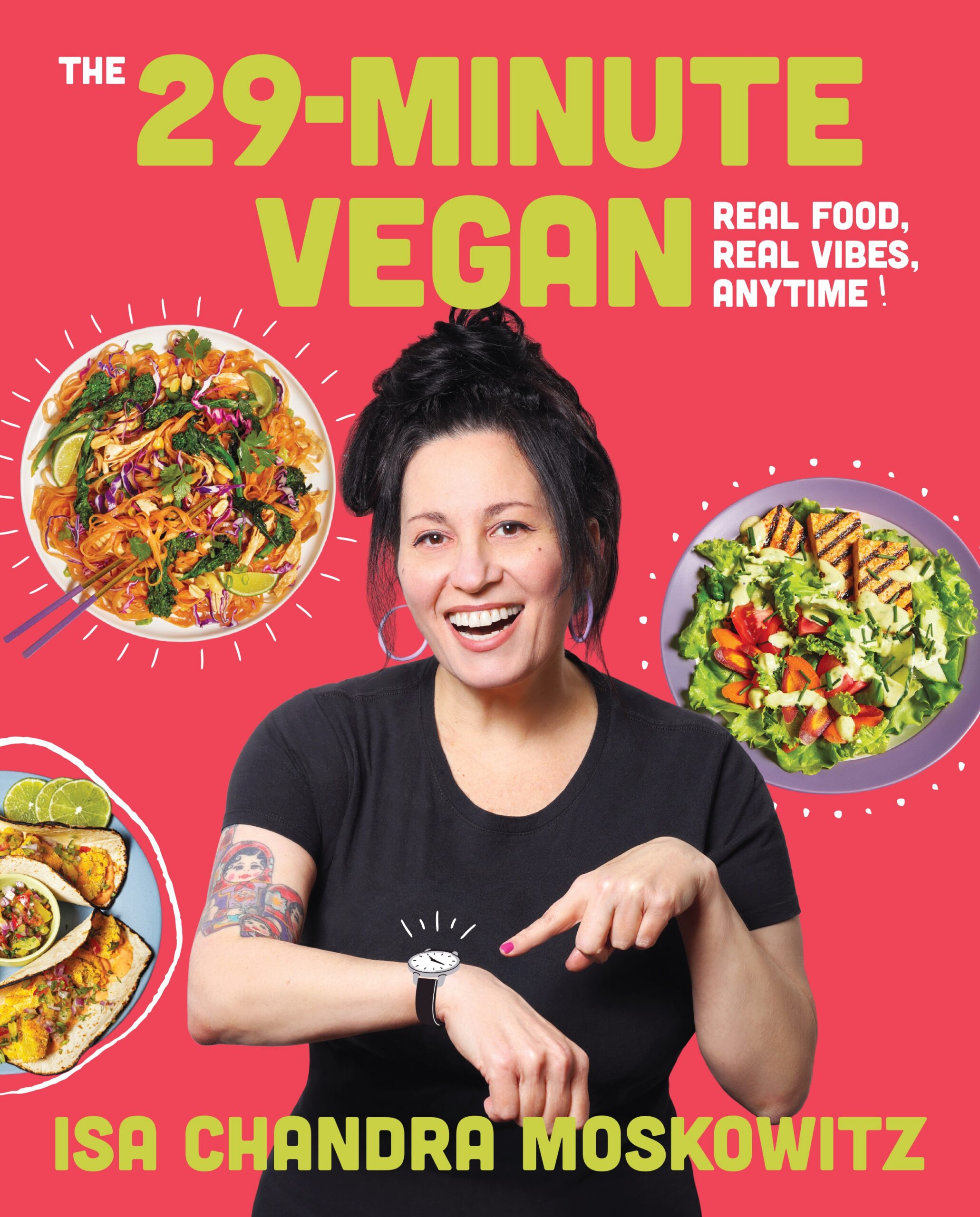
And so, veganism is in a sticky spot. But Isa Chandra Moskowitz and other like-minded chefs and cooks are not calling it quits just yet. Since closing her restaurants, Moskowitz has released a new cookbook — her 12th, in April — that aims to capture a different zeitgeist. Life is hard enough, it seems to acknowledge, cooking shouldn’t be. So on the heels of her last book, which contained dozens of labor-intensive recipes for from-scratch fake meats and cheeses, Moskowitz has pivoted to offer readers something entirely different: “The 29-Minute Vegan.” The book promises vegan food that’s simpler, faster; fewer ingredients, more flow state. As Moskowitz said recently, “I just wanted to do something that was accessible and fun and very easy, ’cause ‘Fake Meat’ was so hard. … I wanna just do my quick, easy cooking that I do every day.” And that wink-wink title? (We’ve seen a zillion 30-minute recipes, after all.) It’s an invitation to make vegan cooking less serious.
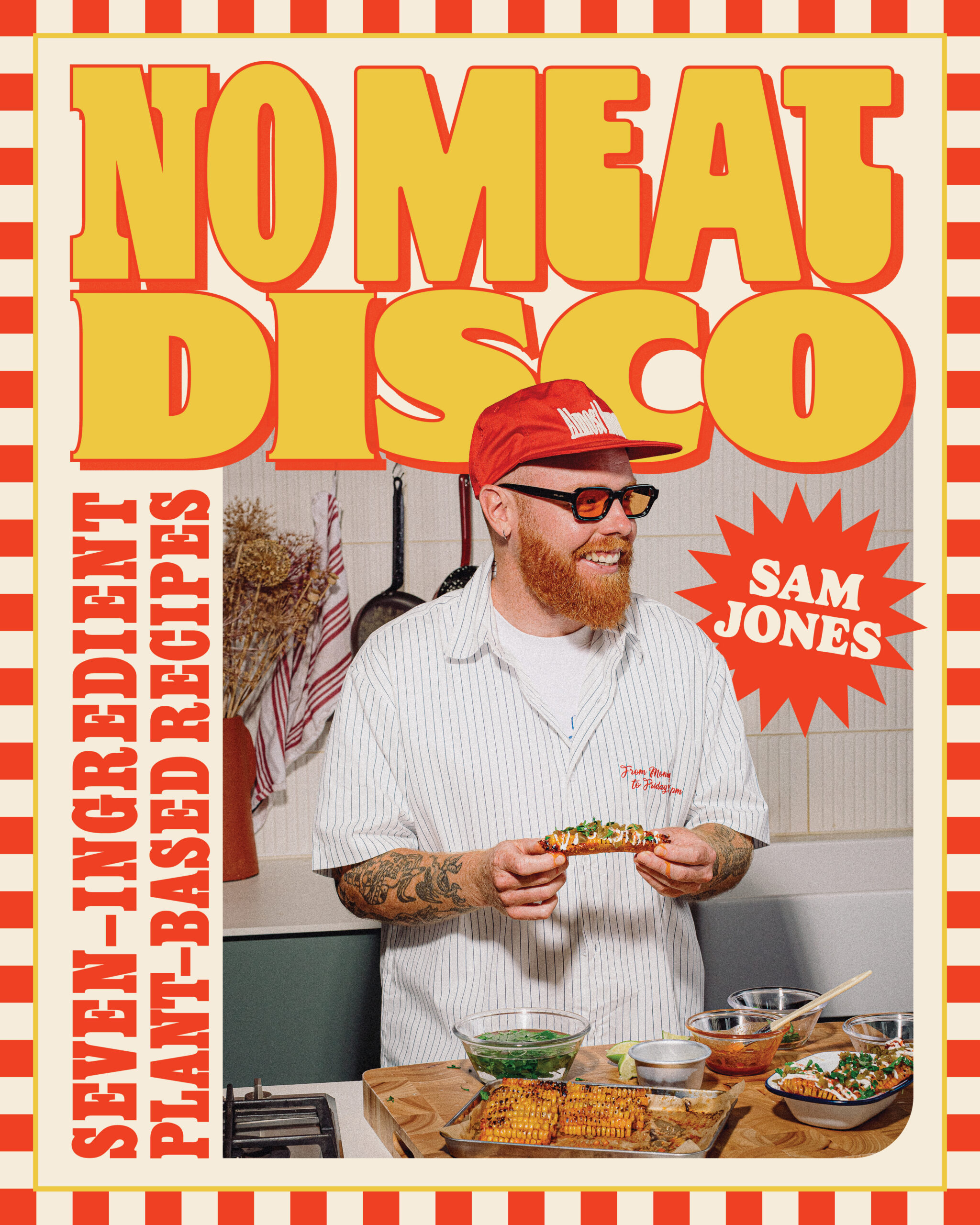
Moskowitz isn’t the only vegan cook to see this sea change and ride the wave. Sam Jones, a self-taught chef and content creator, is publishing his first book, “No-Meat Disco: Seven-Ingredient Plant-Based Recipes,” in September (he’ll have some healthy competition from Carleigh Bodrug’s PlantYou series as well: Her new book, Quickies, comes out later that month). Where Moskowitz is the quintessential Gen-X vegan, a post-punk rocker whose ’90s Public Access show featured live bands with names like Stupid and Made Out of Babies, Jones is her millennial counterpart: Also driven by a passion for music — it plays a big role in his social feed, his food and, now, his cookbook — Jones got his start on modern-day Public Access, aka the internet. There, he has reached more than 1.1 million followers across multiple platforms. He describes his book as “for everyone who loves good food, good music, and good vibes.”
Jones says he is “on a mission to show meat-eaters that going plant-based can be sexy, sustainable, and simple.” He wants to make the food fun, yummy, accessible. Hence the focus on only seven ingredients per recipe (not including staples like olive oil or salt) and the playlists that accompany each and range in genre from rap to electronica. (The playlist concept is not new: Vegan chef Bryant Terry’s cookbooks, for one, have included them for years.) Jones writes, “This book isn’t about rules or labels; it’s about helping you appreciate plants as the star of the show. I’m not here to push a message or convert anyone. I just want to show you how damn good cooking with whole ingredients can be.”
When Moskowitz talks about her hopes for “29-Minute Vegan,” and what readers will take away from it, she mentions the pressure that people often feel around food. And that can be especially tough for people who are trying to eat all (or more) plant foods in a very meat-centric world. There’s a barrier to entry, a sense that “going vegan” must be all or nothing, or a big weighty decision fraught with clear notions of right and wrong. Veganism has an image problem. Moskowitz offers the example of a meat-and-potatoes uncle who said he’d “never” eat a vegan knish; he was surprised when she turned to him and said “Well, you are. That’s what we’re eating. ‘Cause we made vegan knishes, and we’re eating them and enjoying them.”
Vegan food is comfort food
The bad rap is perhaps as much about an old-fashioned notion that plants = rabbit food as it is that it’s hard to make them delicious. But maybe we’ve all just been overthinking it; maybe the solution is actually very simple. As Moskowitz says, “I guess I don’t think [veganism’s image] is a problem to solve. I just think, Cook good food and it will solve itself. The biggest thing is, there’s this self-conscious culture of ‘you’re doing it wrong.’ … Obviously you want your food to taste good, and you want it to be done right, but I just hope that people see you … don’t have to stress so much about it. You can get really delicious flavors easily. You don’t have to find the perfect way to cook tofu.” And that’s especially true at home, where we don’t need to concoct elaborate dishes in order to charge higher prices or justify our very existence. Unlike at a restaurant, the goal of home cooking is feeding yourself and your people, not wowing customers or keeping your business in the black.
Beyond simplicity and accessibility, both Moskowitz and Jones lean into the importance of food as comfort. Yes, it’s meant to fuel us and provide essential nutrients, but joy is an equally essential part of the equation. When asked about the nutritional benefits of eating plant-based (a phrase Moskowitz says she finds grating, by the way, “like ‘infotainment’”), she emphasizes that she’s never been a “health vegan” and that she’s “never touting veganism as a healthier way.” Jones, for his part, writes that his “plant-based journey [is] a disco for the senses.”
Whatever we call it — vegan, meatless, meat-free, plant-based — if we want to save it, these authors suggest, we need to make it equal parts easy and delicious. It has to be low-lift, satisfying and, maybe most important, comforting. “I mean, what else would anybody want?” says Moskowitz. “Uncomforting food?”
Recipe: Baba Ghanoush Pasta
Isa Chandra Moskowitz, “The 29-Minute Vegan”
Serves 4
Baba ghanoush is one of my ultimate comfort foods. If I see it on a menu, you can bet I’m ordering it. There’s something about dipping warm pita into that velvety, smoky eggplant dip that just hits the spot every time. The creamy eggplant that melts in your mouth, the toasty tahini, the bright tang of lemon, and the perfect kick of spice — what’s not to love?
So, if I’m already obsessed with scooping it up on bread, it makes sense I’d love it all over pasta. A creamy, nutty, spicy sauce with meltingly tender slices of eggplant. A hint of cumin, garlic, and thyme. And then you crown it with fresh lemon slices and toasty pine nuts, adding that extra pizazz. You’ll never see dip the same way again.
Ingredients
1 teaspoon salt, plus more for cooking the pasta
1 pound fusilli
1 medium eggplant
3 tablespoons olive oil
4 cloves garlic
½ cup (50 g) plain breadcrumbs
½ teaspoon dried thyme
½ teaspoon dried oregano
½ teaspoon ground cumin
¼ teaspoon sweet paprika
¼ teaspoon ground black pepper
⅓ cup (80 g) tahini
¼ cup (60 ml) lemon juice
1½ cups (360 ml) vegetable broth
For garnish
¼ cup (34 g) pine nuts, toasted
Roughly chopped fresh parsle
1 lemon, thinly sliced, seeds removed
Method
Bring a large pot of salted water to a boil. Add the pasta and cook according to the package instructions to al dente. Drain and place back in the pot.
Preheat a large skillet over medium-high heat. Cut the eggplant into ¼-inch (6 mm) thick semicircles. Add the eggplant to the pan. Sprinkle with ½ teaspoon of the salt and drizzle with the oil, tossing to coat. Spread it out into as much of a single layer as you can, but don’t worry too much about overlap. Flip occasionally until the eggplant is softened and lightly browned, 8 to 10 minutes. It’s okay if it starts to fall apart.
You can mince the garlic now and prepare the garnishes.
Add the minced garlic, breadcrumbs, thyme, oregano, cumin, paprika, remaining ½ teaspoon salt, and the pepper and toss to coat. The breadcrumbs should toast and become a few shades darker in about 2 minutes.
Fold in the tahini, lemon juice, and vegetable broth, stirring well to incorporate, and cook for about 2 minutes, until the sauce thickens. Taste for salt and seasoning.
Gently fold the saucy eggplant into the pan with the cooked pasta. Divide among bowls and top each serving with pine nuts, parsley, and lemon slices.
Reprinted from The 29-Minute Vegan: Real Food, Real Vibes, Anytime, published by Abrams. Text copyright © 2026 Isa Chandra Moskowitz, Photographs copyright © 2026 Anna Sergeeva, Cover © 2026 Abrams
Recipe: Mushroom Brisket Burger
Sam Jones, “No-Meat Disco”
Makes 2 to 3 burgers
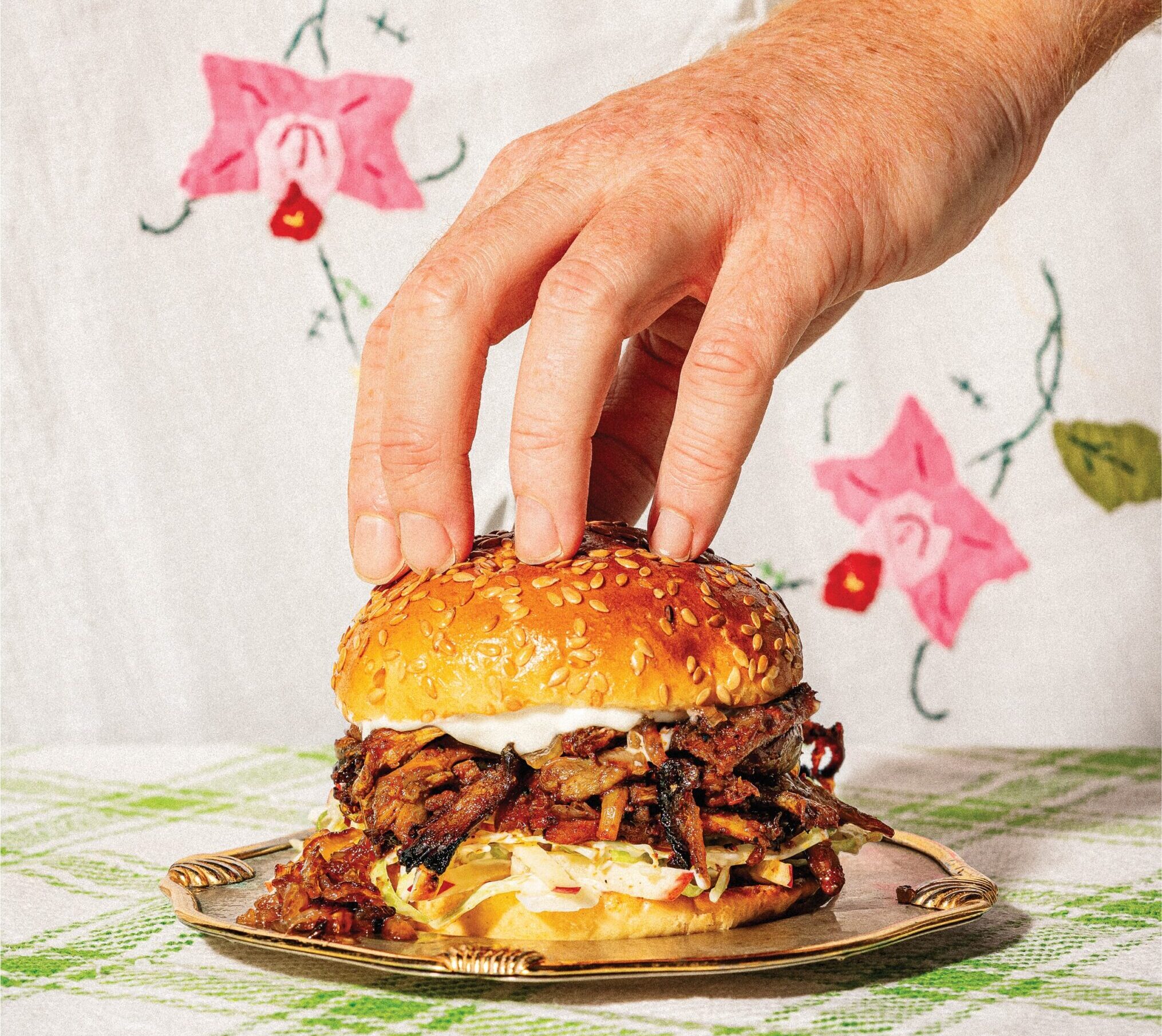
Pulled oyster mushrooms are the GOAT of all mushrooms and the best way to eat them. When I discovered this flavor profile and technique of cooking these mushrooms, there was no going back. Fully obsessed. Combining mushrooms with the sticky caramelized shallots and crunchy apple slaw, the textures are so perfect. I love this one.
7 Ingredients
5.3 ounces (150 g) oyster mushrooms
2 teaspoons Easy Shawarma Paste (see below)
2 large shallots, thinly sliced
4.3 ounces (120 g) white cabbage, thinly sliced
1 red apple, cored and cut into thin matchsticks
2 tablespoons plant-based mayonnaise
2 plant-based brioche burger buns
Extra Ingredients
Olive oil
Salt and freshly ground black pepper
Method
Preheat the oven to 400°F (200°C).
Pull your oyster mushrooms into strips. Place them in a large bowl with the shawarma paste, a drizzle of olive oil, and a generous pinch of salt and pepper. Mix well until fully coated.
Spread out the mushrooms on a large ovenproof skillet or baking sheet and roast in the oven for 15 to 20 minutes, tossing at about the 18-minute point. They should develop a slight char on the edges.
Meanwhile, heat a little olive oil in a medium saucepan over medium-low heat. Add the shallots with a pinch of salt and cook for about 20 minutes, stirring frequently to prevent burning. They should soften and turn beautifully sticky—this should take roughly the same time as the mushrooms.
Meanwhile, combine the cabbage, apple, and mayo in a medium bowl. Mix well, then season with a pinch of salt and several cracks of pepper.
Next, spread a layer of the mayonnaise mixture on your burger buns. Heat a large nonstick skillet over medium-low heat and toast the buns, cut side down, for 1 to 2 minutes, until golden and crisp.
To assemble, place the bottom of each bun on a plate and spoon on some of the apple slaw. Top with the pulled mushrooms, followed by the sticky shallots. Add the top bun to each bun.
Excerpted from NO MEAT DISCO: 7-Ingredient Plant-Based Recipes By Sam Jones, copyright ©2026, reprinted by permission of Countryman Press, an imprint of W. W. Norton & Co., Inc. All rights reserved.
Recipe: Easy Shawarma Paste
Makes 20 servings
You’ll spot this paste in the Mushroom Shawarma Pita recipe (page 96), but I actually use it loads across different dishes. It’s full of bold flavor and works perfectly with mushrooms or chickpeas. Keep a jar in the fridge for quick meals (you can sometimes find it in supermarkets, too).
7 Ingredients
1 teaspoon ground cumin
1 tablespoon ground allspice
1 teaspoon ground turmeric
1 tablespoon tomato paste
1 tablespoon smoked paprika
1 teaspoon garlic powder
1 teaspoon chili powder
Extra Ingredients
1 tablespoon extra-virgin olive oil
1 tablespoon salt
1 tablespoon freshly ground black pepper
Combine the cumin, allspice, turmeric, tomato paste, paprika, garlic powder, chili powder, olive oil, salt, and pepper a small bowl and mix together.
Transfer to a sterilized jar and store in the fridge.
Excerpted from NO MEAT DISCO: 7-Ingredient Plant-Based Recipes By Sam Jones, copyright ©2026, reprinted by permission of Countryman Press, an imprint of W. W. Norton & Co., Inc. All rights reserved.
Related Posts
 Cooking Sustainably, Local Food & Farmers Markets
10 ways to save money at the farmers market
July 31, 2026
Fresh, local, seasonal food is for everyone. Use these money-saving tips to get the most from the farmers market.
 Cooking Sustainably, Local Food & Farmers Markets
How to spot a true farmers market
July 30, 2026
As peak season begins, here's how to spot a true farmers market and know where your produce really comes from.
 Cooking Sustainably, Food Waste
Beyond fermentation: A new book explores the many methods of food preservation
July 17, 2026
While fermentation may be the food trend of the moment, Julia Skinner's new book explores the full spectrum of food preservation techniques.