
You haven’t had wasabi until you’ve had it fresh — and local
“There’s nothing like having freshly grated wasabi with Japanese food,” says Kate Koo, who has more than enough experience to know. As the sushi chef of Zilla Sake in Portland, Oregon, Koo has familiarized herself over the years with the subtleties between different preparations and cultivars: Bright-green Daruma wasabi, for example, is “super vegetal in taste,” but Mazuma wasabi, her personal favorite variety, is earthier. It’s also thicker in consistency when grated, she finds, and, when sliced open, has a lovely pink-purple starburst running through the middle.
At the restaurant, Koo makes a point of keeping her fresh wasabi in plain view on the sushi bar — in part because, as she’s noticed, many customers don’t know that wasabi comes in so many varieties. In fact, many of them have never seen fresh whole wasabi in person at all.

You may know wasabi as the pasty green daub next to the pickled ginger on a sushi platter, but chances are, the condiment you’ll get at a restaurant is a green-dyed imitation. Most “wasabi” sold in the U.S. is actually a rehydrated powder based on horseradish. Though ubiquitous, it’s unrecognizable from the long, nubbly rhizomes — enlarged stems that grow underground like roots — of the true wasabi plant.
Why is fresh wasabi so elusive?
Wasabi, Eutrema japonicum, is native to parts of East Asia — especially Japan, where it has been consumed as food and medicine for millennia and where most of the highest-quality wasabi is still produced. All the parts of the plant are edible, but the rhizome is most prized. Grating it triggers the chemical reaction responsible for its distinctive pungency. But the heat begins to fade within an hour or so, meaning it’s a delicacy that’s best enjoyed as soon as it hits your plate.
Japan does export some of its wasabi, including to high-end sushi restaurants around the world. Once harvested, though, the rhizomes stay fresh only for a matter of weeks; transport requires delicate handling and specifically calibrated refrigeration and insulation, so they are typically shipped express out of Japan to maintain quality, all of which adds up to a pricy product. For reasons of both convenience and budget, the powdered stuff makes more sense for most restaurants’ bottom lines.
The demands of wasabi cultivation itself are also part of why it’s such an exclusive specialty crop. “It takes a lot of patience and commitment to grow wasabi,” explains Olaf Lange, farm manager at Hawai‘i-based Volcano Wasabi. Not only that, but “it’s a sensitive plant, somewhat finicky,” and prone to several diseases, especially blackleg, a fungal pathogen that spreads easily and kills quickly. “The process takes over eighteen months start to finish,” Lange adds. “That’s why it’s so expensive.”
The horseradish products used at most restaurants in the U.S. can make a serviceable substitute. Like wasabi, horseradish is a member of the Brassicaceae family, and it has a similar nose-clearing effect. The plant itself is much easier to grow on an industrial level, and though its flavor is far less complex than wasabi’s, it’s also much easier to preserve. In addition to horseradish, imitation wasabi powders typically also contain hot mustard, cornstarch and food coloring to mimic wasabi’s characteristic green; chefs can easily mix the shelf-stable product with water to make a paste. The Food and Drug Administration has not set a “standard of identity” for wasabi, and the lack of regulation around the term has created a labeling gray area —hence the proliferation of horseradish-based imitations.
Still, not every wasabi product you see will be entirely wasabi-free. Freeze-dried wasabi powders are also available, for example, and Zilla uses a frozen product from Japan for its house wasabi, which contains mostly fresh grated rhizome with a bit of horseradish to make up for lost flavor. But the restaurant does offer fresh-grated wasabi as an add-on option — and for that premium product, Koo says, “it’s more cost-effective to get it locally.” For restaurants that can’t afford fresh rhizomes from Japan, U.S.-grown wasabi might be the next best thing. Or better.
An emerging domestic industry
Koo sources her fresh, water-grown rhizomes from Oregon Coast Wasabi, whose greenhouse farms are located just a couple of hours outside of Portland. It started with a cold call, she says: “They were like, ‘Hey, have you ever thought about having locally grown fresh wasabi?’ I didn’t even know that this was a thing. So I tried it out, and I’ve literally had a standing order every single week with them since.” Compared to the alternatives, there was no competition: “Dried apples taste awesome, but a fresh, crunchy, sweet, juicy apple in the fall in Oregon? It’s kind of the same thing.”
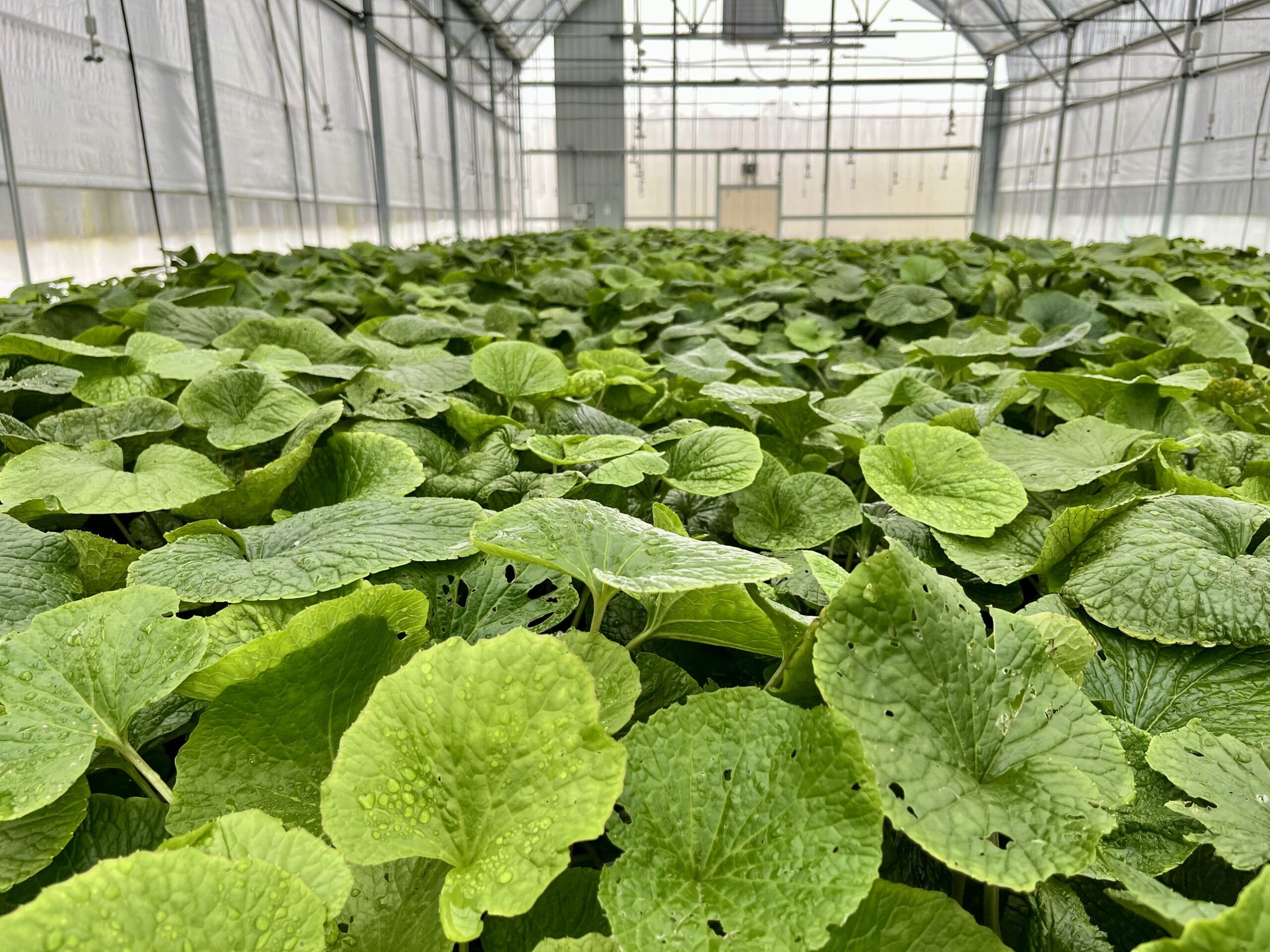
Oregon Coast is one of a handful of small farms in the western U.S. and Canada that have experimented with this specialty crop in recent years. The Pacific Northwest and Northern California, with their cool, moist climates, are especially promising. Pacific Coast Wasabi, for example, has a successful commercial operation with farms in both Washington and British Columbia; near San Francisco, Half Moon Bay Wasabi has been growing in greenhouses since 2011, becoming a go-to purveyor for restaurants around the Bay Area. Volcano Wasabi, located high in the mountains of Hawai‘i’s Big Island, made its first planting in April 2023.
Jon Kindred, Volcano’s founder and CEO, became passionate about the ingredient while living in Japan. When he retired to Hawai‘i, he says, “I realized I liked wasabi too much not to have the real thing.” He first considered growing wasabi around his home on Maui, but the climate wouldn’t allow it — too much heat and sunshine. In 2021, he bought a higher-elevation farm on the Big Island, leasing a greenhouse from the University of Hawai‘i’s College of Tropical Agriculture and Human Resilience while he finalized his own infrastructure.
The Volcano farm looks a little different from the most traditional wasabi farms in Japan. “The typical natural growing environment is gravelly stream beds or river beds,” Kindred explains, and Japanese growers will often mimic the plant’s habitat with semiaquatic cultivation. “Replicating that is very challenging,” Kindred says — many U.S. states prohibit planting crops in natural streams, for example — “and it’s also exposed, environmentally,” so the farmer has less control.
Instead, the Volcano team settled on an ebb-and-flow hydroponic system. “We experimented with growing them organically as well, and we had some success with that,” Lange says. “To do it on a commercial level, though, hydroponics made more sense.”
Carol Miles, a horticulture professor and “new crops” specialist at Washington State University, also sees potential in growing in soil, a method she first observed several decades ago during a research trip in Taiwan. “They grow wasabi in soil under a forest canopy, up in the highlands where it’s cooler,” she explains. “It was evergreen forests, pine trees — and I was like, ‘Well, we have pine trees in Washington.’ I saw the opportunity there.” A site doesn’t even necessarily need forest canopy: “To mainstream this crop, I think that it can work in high tunnels,” Miles says, provided the soil mix is right and provides adequate drainage. “To me, you could put that in the ground anywhere.”
The question of supply
More so than the actual method, Miles says that one significant barrier to getting a wasabi farm up and running in the U.S. is the plant material itself. There’s little domestic supply, and buying from Asia typically comes with a no-propagation clause. Without that, the process would be simple: The rhizome sends out offshoots that can be easily collected and replanted, and “in Asia, they basically take out those daughter plants with a little bit of tissue and replant them,” Miles explains, “and they’re on to their next crop.” U.S. farmers, on the other hand, have to come back for more high-priced plants. At a certain point, “Your costs of production are too high.”
Miles notes that during her time working with wasabi, several partner labs found success with an alternative method that could make plant material more available and affordable to U.S. farmers. Tissue culture (that is, growing starter plants from small pieces of plant tissue) is a reliable option for producing new plants simply and quickly. “Because you go back to clean plant material,” Miles says, it helps mitigate the plant’s disease problem, too. Still, nurseries in the U.S. have not yet made the effort to bring the approach to scale. “I think what it’s going to take is somebody in that marketplace to say, ‘I’m targeting this crop,’ [even though] we’re not going to sell millions of them,” Miles adds.
At Volcano Wasabi, Kindred and Lange have chosen the third route: growing from seed, which they’ve done with assistance from the Japanese wasabi company Kinjirushi. “They actually came to Hawai‘i and looked at my site,” Kindred explains. “They found it interesting, and it contributes to their body of knowledge to see how wasabi grows in different growing mediums and environments. … They want to see us succeed.”
Plans are in the works to eventually start propagating via tissue culture. “We’ve got a pretty big gene pool to pick from,” says Lange, who will take time selecting the best specimens to reproduce. “Certain plants just have better resistance to pathogens and better growth patterns that suit the style we’re growing,” he explains — but the flavor will be a consideration, too.
Where wasabi goes from here
There are a lot of reasons that domestic fresh wasabi might appeal to chefs and home cooks alike. Though the price tag is high under any circumstances, U.S.-grown wasabi can be more cost-effective than rhizomes imported from Japan — especially in light of the recently announced 15 percent tariff on Japanese goods. With less distance to travel and fewer storage requirements, it will be fresher, too, and likely responsible for fewer emissions.
“And now with wasabi, people are just now understanding what's real versus what's fake stuff. But once [people become] more acclimated, I could see a tremendous market development and demand.”
Though the domestic wasabi industry is in its early days, Kindred is optimistic. “When I grew up in Ohio, nobody even knew about sushi,” he says. “And now with wasabi, people are just now understanding what’s real versus what’s fake stuff. But once [people become] more acclimated, I could see a tremendous market development and demand.” In Hawai‘i, he’s seen the demand firsthand from restaurants and direct-to-consumer clients alike: “The locals now are attracted to it as being something locally grown,” he says. “It sells itself in that way.”
Koo has seen a similar reaction from her customers. “People do get really excited about it,” she says, adding that “it’s really cool to be able to use the full plant,” since getting leaves and stems from Japan is difficult. And she predicts, as does Kindred, that as awareness and local availability expand, so too will the applications of fresh wasabi in all kinds of cuisines.
“Wasabi is obviously great in Japanese food, but it’s cool to see that it’s making its way into the rest of the culinary world,” Koo says. “It’s not super economical to use, but it’s absolutely worth it.”
Get the latest food news from FoodPrint.
By subscribing to communications from FoodPrint, you are agreeing to receive emails from us. We promise not to email you too often or sell your information.
Top photo by Wirestock Creators/Adobe Stock.
More Reading
Can nutritious and sustainable hickory oil compete in a crowded cooking oils market?
March 19, 2026
Tradwives, MAHA Moms and the impacts of "radical homemaking"
December 10, 2025
Food Freedom advocates cite the benefits of deregulation. Food safety is not one of them.
November 21, 2025
How urban orchards improve a community's access to fresh, healthy food
October 30, 2025
Beyond pecan pie: Growers look for new markets for this native nut
October 24, 2025
School meals are about to get a lot less local — and less healthy
October 22, 2025
Why you should seek out local whole-grain flour, and how to use it
October 15, 2025
From Ludacrisp to Cosmic Crisp: How new apples are bred
October 8, 2025
Preserving heirloom date varieties in the Coachella Valley
August 21, 2025